

The fall edition of " Career Fair "PJAIT is coming up tomorrow—October 22!


Artificial intelligence is no longer a distant vision of the future—what was once considered a futuristic concept is now standard practice for developers around the world. However, AI in programming does not mean replacing humans; rather, it serves as a catalyst for change, allowing coders to move away from repetitive tasks in their work toward creative design and advanced problem-solving.
In programming, AI refers to the use of machine learning algorithms andlarge language models (LLMs) to assist, automate, and accelerate the work of software developers. These tools can generate code, detect errors, write documentation, suggest refactoring, and guide developers through less familiar libraries or frameworks.
The key difference from traditional development tools is that AI understands context—not just syntax. Models such as GPT-4 and Claude analyze the entire codebase, recognize design patterns, and suggest solutions that align with previously established project conventions.
The most obvious and common use of AI in programming is to assist with writing code. Tools such as GitHub Copilot, Cursor, and Amazon CodeWhisperer suggest entire snippets of code in real time, predicting the programmer’s intentions based on comments and existing code.
GitHub Copilot supports virtually all popular programming languages—from Python and JavaScript to TypeScript, Ruby, Go, and C++—and can analyze the context of an entire project.
A particularly valuable feature is the ability to instantly generate "boilerplate code"—reusable, template-based code snippets, such as configurations, CRUD (Create, Read, Update, Delete) operations, or test setups. The developer describes what they need in a comment, and the AI provides a structure that simply needs to be adapted to the specifics of the project.
Error diagnosis is one of the areas where AI makes the biggest difference for developers. Instead of painstakingly analyzing stack traces, developers can paste an error message directly into an AI tool and receive a diagnosis along with a suggested fix.
To do this, static code analysis (SAST) tools such as DeepCode are used, which automatically scan the entire project codebase for vulnerabilities, anti-patterns, and inconsistencies—and instead of simply flagging an error, they suggest specific ways to fix it.
What’s more, modern AI systems make it possible to build automated pipelines that monitor production logs in real time and respond to errors without human intervention.
AI also effectively identifies—to put it simply—inefficiencies in the code: duplicated code, overly complex classes, performance anti-patterns, and "code smells."
So, in larger projects where manually reviewing the entire codebase is impractical, artificial intelligence has become the first line of quality control—it identifies areas that need refactoring and helps maintain a clear architecture as the project grows.
Creating technical documentation is one of the most time-consuming and often neglected tasks in software development projects. AI can automate this process—generating function descriptions, code comments, or entire README files based on an analysis of the source code.
ChatGPT and Claude particularly excel at tasks that require a deep understanding of context and the creation of clear technical documentation.
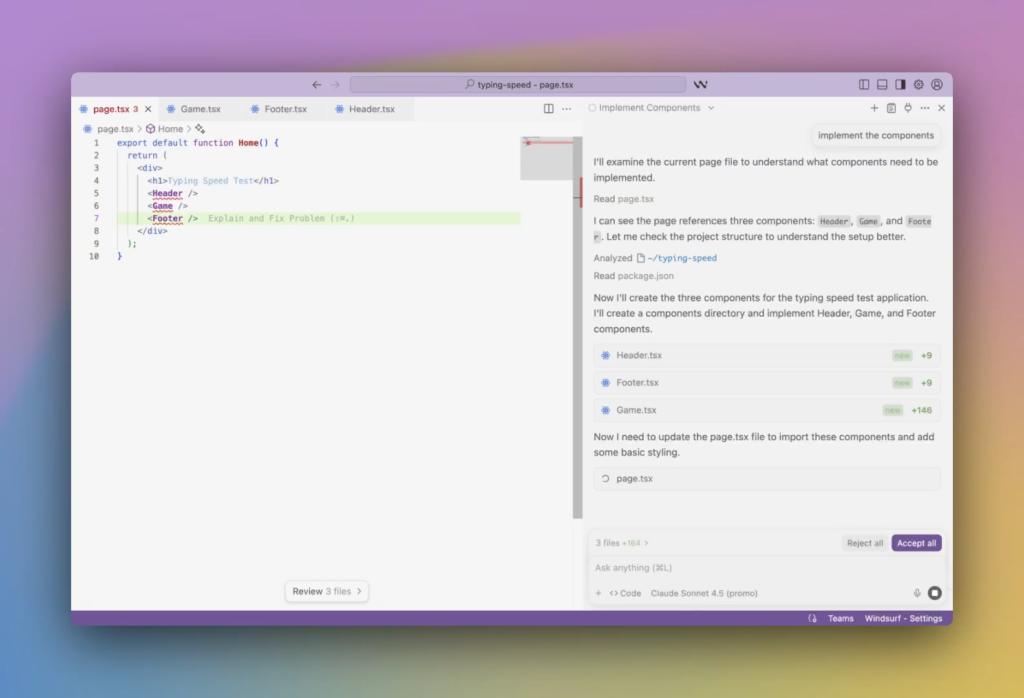
Tools such as Windsurf AI specialize in eliminating defects early in the development process by automatically generating tests and detecting defects in the code structure. This allows teams to respond more effectively to issues, thereby improving the quality of the final product.
Modern AI tools can analyze existing code and automatically generate a set of unit tests—without requiring the developer to manually define each test case.
One of the most groundbreaking trends in recent months is " vibe coding "—a term that describes AI-assisted programming driven by natural language: instead of writing code line by line, the programmer describes the desired outcome, and the language model generates a working solution.
Vibe Coding shifts the paradigm of work—from a "what do I need to type" approach to "what result do I want to achieve"—which significantly increases the pace of work and drastically reduces the time it takes to deliver working functionality compared to traditional coding methods.
However, it’s important to remember that vibe coding does not replace in-depth programming knowledge. Without a programmer’s understanding of the code generated by AI tools, the final result may contain logical errors or even vulnerabilities that could be exploited.
This is because such code can be repetitive, based on incomplete data or poor patterns, and modifying it manually later on is difficult if the programmer does not fully understand its logic. If AI writes code on its own without a programmer’s supervision, the risk of security vulnerabilities and hard-to-detect logical errors increases.
Beginner programmers are particularly prone to such errors—so how can they be avoided? AI-generated code should be regularly reviewed and subjected to security audits, rather than automatically accepted. Vulnerability analysis tools and up-to-date libraries are essential, but it is equally important to maintain your own understanding of the project’s architecture—a programmer who does not know what the AI generated and why is unable to detect logical errors or vulnerabilities that may only become apparent in production.
Effective use of AI in programming also requires mastering prompt engineering —the art of precisely formulating instructions for language models. This isn’t just about typing in queries; a well-designed prompt includes context, format expectations, examples, and step-by-step instructions.
Key prompting techniques useful for programmers include:
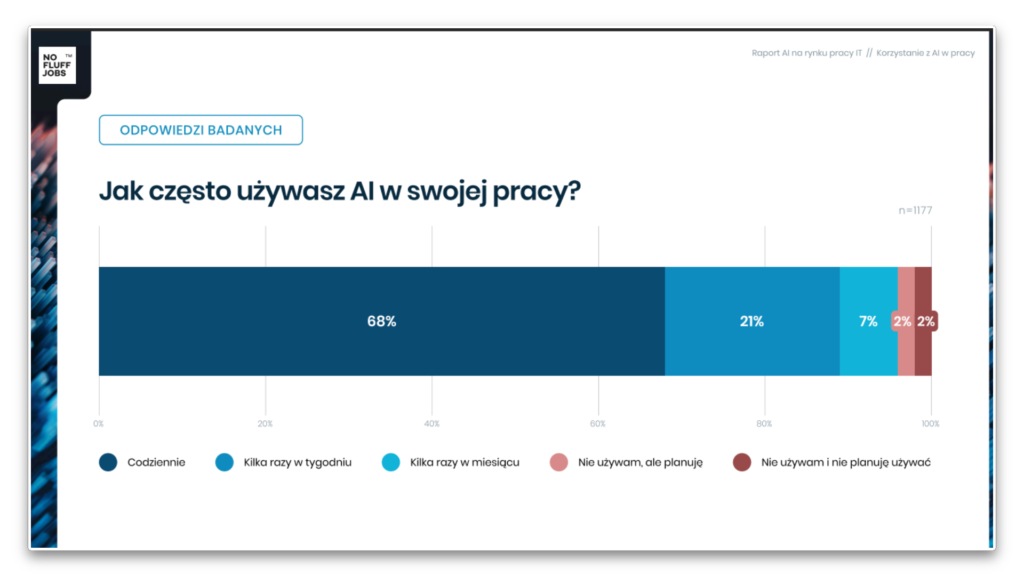
The picture of the Polish tech industry that emerges from No Fluff Jobs’ report, “AI in the IT Job Market,” is clear evidence that AI is not just a trend for developers—it’s part of their daily routine. As many as 68% of people in the IT industry use AI tools every day, and another 21% use them several times a week, which means that practically 96% of professionals come into regular contact with them.
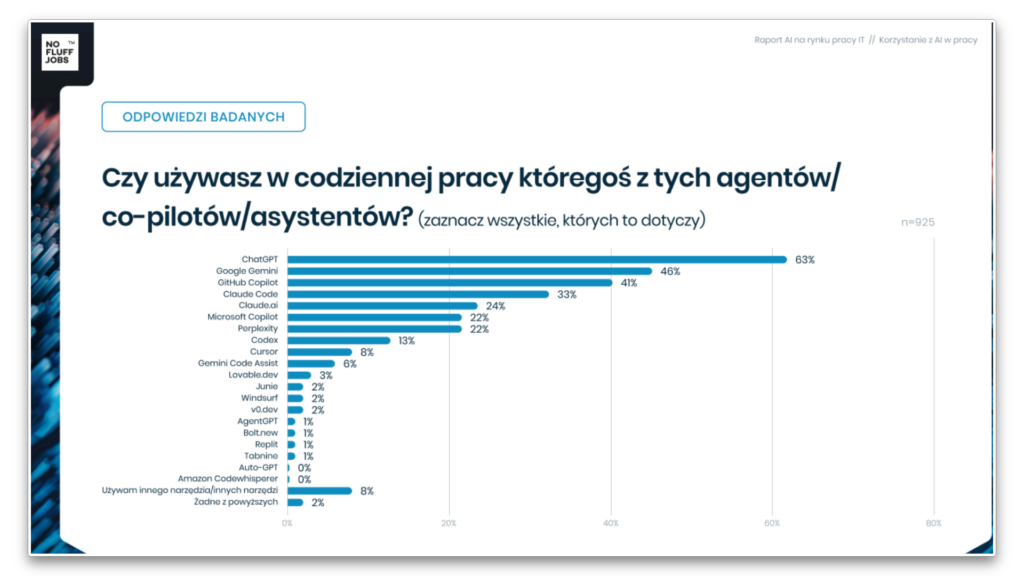
ChatGPT remains the most widely used AI tool in the Polish IT sector, with 63% of surveyed professionals using it. AI solutions from Google (46%), GitHub Copilot (41%), and the Claude family—Claude Code was cited by 33% and Claude.ai by 24% of respondents—also hold strong positions.
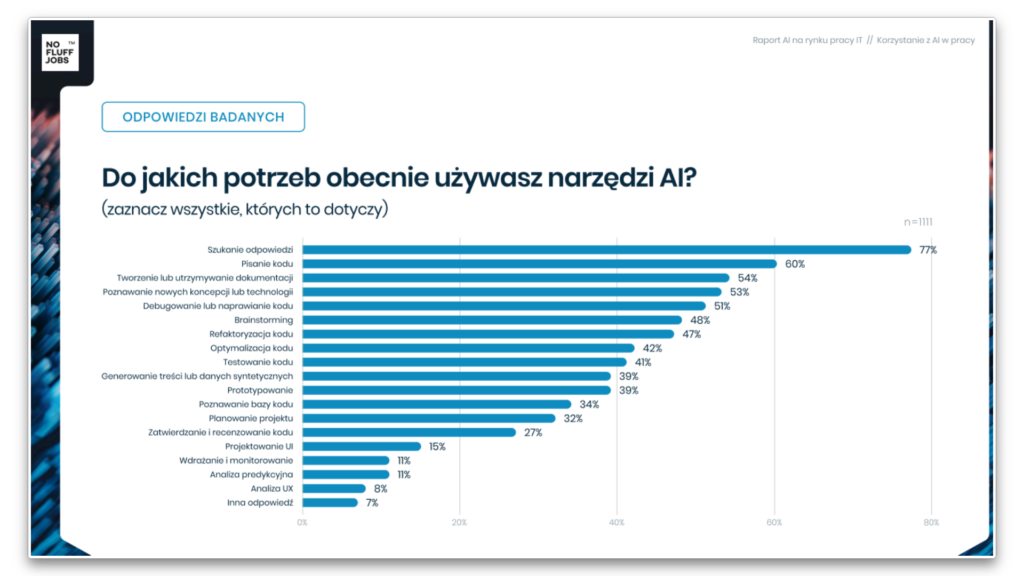
The primary use of AI tools by IT professionals is to find answers to technical questions (77% of respondents); a slightly smaller percentage use them for writing code (60%) or creating documentation (54%). In turn, the debugging, refactoring, and testing discussed above are also among the top 10 uses of artificial intelligence in the work of Polish programmers.
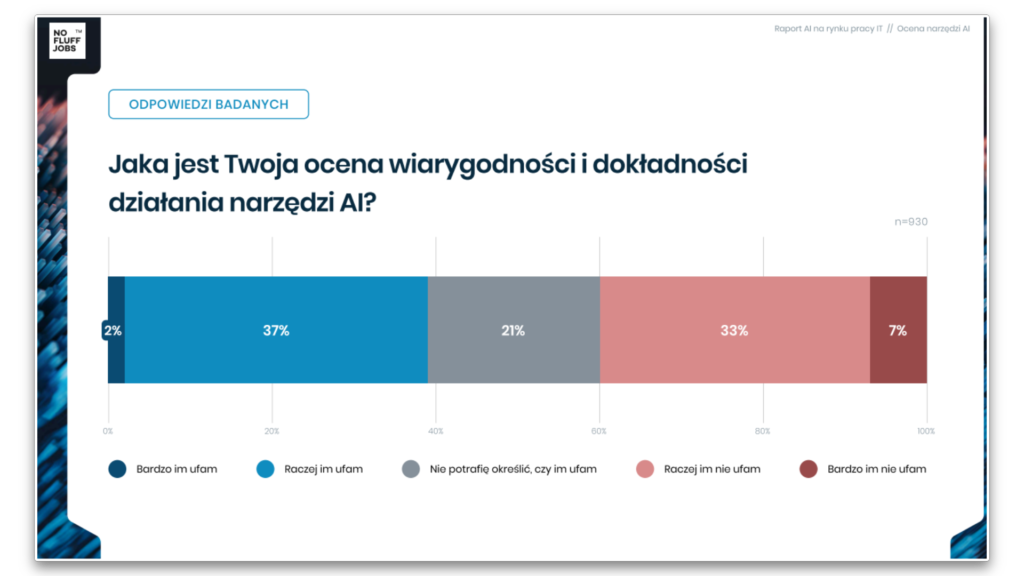
At the same time, this report reveals a complex picture of trust.
Although 88% of respondents rate the usefulness of AI at work highly, only 2% say they have complete confidence in its accuracy.
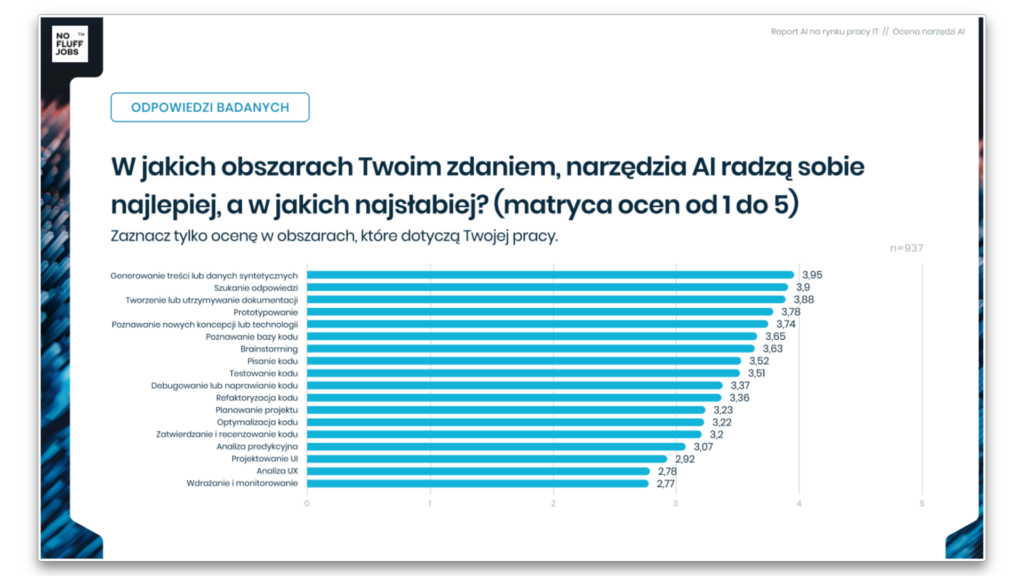
On a scale of 1 to 5, AI receives the highest ratings for content generation and synthetic data (3.95) and finding answers (3.90), while implementation and monitoring (2.77) and UX analysis (2.78) are areas where IT professionals rate AI significantly lower.
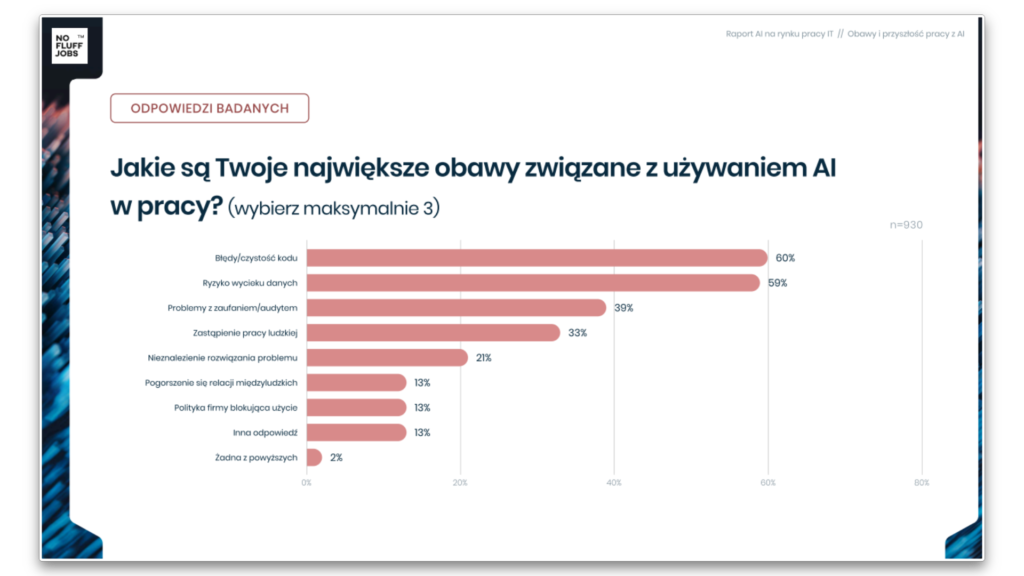
The main concerns regarding AI center on errors and the poor quality of the generated code (60% of responses) and the risk of data leaks from the data fed into the models (59%).
AI isn’t replacing programmers—it’s radically transforming their role. They are evolving from mere executors of code instructions into system designers, key decision-makers on structural issues, and auditors of the correctness and quality of solutions.
The key to success in the job market will be the ability to combine knowledge ofpopular programming languages —such as Python and JavaScript, which AI understands best due to the abundance of training data—with the skills to work effectively with language models. Python is particularly valuable because it is the foundational language of the AI/ML ecosystem, making it an exceptionally attractive choice to learn today.
Those who wish to systematically develop their skills in AI programming should consider formal educational pathways. The computer science program computer science PJAIT covers not only a solid foundation in traditional programming but also skills in working with AI, prompt engineering, and critical thinking about algorithm-assisted design.
Individuals with programming experience who wish to delve deeper into AI applications can enroll in the postgraduate program "Python – Artificial Intelligence Programming" atPJAIT. This program combines practical programming skills with knowledge of machine learning models—skills that are increasingly in demand in the job market.
The transformation of the programming profession in the age of AI is a reality—but it is also an opportunity. Those who learn to use AI tools consciously and strategically will be better prepared for the challenges of a rapidly changing job market.
The findings of the No Fluff Jobs report mentioned in the article clearly show that while 96% of professionals use AI regularly, only 2% trust its results unconditionally—it is precisely this gap between effective use and critical judgment that will be a key competency for developers in the coming decade.