Enrollment is now open! The application period for the winter semester of the 2026/2027 academic year began on April 8 and will run through September 30.
The "Studies" tab presents the educational offer PJAIT. Check out the educational paths offered by academy choose a program that suits your interests and plans for the future.
The "At PJAITtab is where we show student life at PJAIT the inside. Here you will find information about student initiatives, events at the university, and projects that make up our community.
The "Cooperation" tab contains information about opportunities for cooperation with PJAIT. Here you will find materials for partners, current offers, and useful forms related to activities carried out jointly with the university.
Bioinformatics, Master's degree program, full-time, taught in Polish
Bioinformatics is an interdisciplinary field of study Master's degree program combining programming, artificial intelligence, and life sciences. The program includes three specializations: nucleic acid bioinformatics, structural bioinformatics and proteomics, and applied bioinformatics and technology transfer. We educate professionals ready to work in the biotech, pharmaceutical, IT, and other sectors.
The master's program in bioinformatics at PJAIT students to enter this very field—at the intersection of life sciences, technology, and business.
✅ You’ll develop programming and analytical skills used in biology, medicine, and pharmacy ✅ You’ll learn to work with real biological, genomic, and proteomic data ✅ You’ll explore the applications of machine learning, deep learning, Big Data, and cloud solutions in bioinformatics ✅ You’ll prepare to work on NGS and RNA-seq data analysis, protein modeling, or computer-aided drug design ✅ You can pursue a career in the biotechnology, pharmaceutical, medical, laboratory, research, or IT sectors ✅ You’ll gain the skills needed not only to conduct analyses but also to develop and commercialize bioinformatics products
Important information about the Bioinformatics program:
Curriculum for the year:
2026–2027
“Modern biological sciences generate enormous amounts of data. Genome sequencing, gene expression analysis, protein modeling, and the design of new drugs today require not only biological knowledge but also programming, statistics, artificial intelligence, and efficient data management.”
— dr hab. Kuzdraliński, dr hab. , Prof. at the Polish-Japanese Academy of Information Technology, Head of the Department of Bioinformatics
The program is modular. The first semester establishes a common foundation in Python programming, the Linux environment, mathematics, statistics, and the biological sciences. Students then choose one of three specializations:
— nucleic acid bioinformatics, — structural bioinformatics and proteomics, — applied bioinformatics and technology transfer.
This program is designed for individuals who already hold Bachelor's degree wish to acquire more specialized, interdisciplinary skills—skills that are harder to replace than knowledge limited to a single field.
field of study is offered as a full-time program:
The Bioinformatics program is a full-time program taught in Polish and lasts two years (four semesters).
For full-time programs, classes are typically held Monday through Friday from 8:30 a.m. to 8:45 p.m. Each semester consists of 15 weeks of classes. The academic year runs from October through the end of June and is divided into two semesters. Courses are taught in Polish.
Is bioinformatics the right major for you?
Who is the bioinformatics program at PJAIT intended for?
1. A graduate with a degree in biotechnology or biology
He has laboratory experience and understands biological processes, but he notes that more and more research requires the analysis of large datasets. He wants to learn Python, statistics, how to work with Linux, and genomic data analysis.
Her goal: to work in a diagnostic laboratory, a genomics center, a biotechnology or pharmaceutical company, or a research team.
Best track: nucleic acid bioinformatics.
2. A graduate with a degree in computer science or a quantitative field
He is skilled in programming and data analysis, but he is looking for a field where technology solves problems that have real-world significance for health and science. He is interested in AI, molecular modeling, protein structure analysis, and drug design.
His goal: to specialize in computational biology, drug discovery, proteomics, or AI solutions for the life sciences sector.
Best track: structural bioinformatics and proteomics.
3. A person who wants to combine science, technology, and business
She has a degree in biotechnology, chemistry, environmental science, or field of study . However, she does not necessarily plan to pursue a career exclusively in a laboratory setting. She is interested in product development, research and technology project management, regulations, intellectual property, or the commercialization of research results.
Her goal: to work as a project manager, product owner, or technology transfer specialist, or to develop her own biotech venture.
Best track: Applied Bioinformatics and Technology Transfer.
What tools and technologies will you learn? — Python, R — Data Science — Linux — AI / Machine Learning — NGS — Git — Claud — Docker
Where is AI in the program? AI is present throughout the program—as a tool that supports data analysis, interpretation of results, and process automation.
Do students work with real data? Yes—the program involves working with real biological and medical data.
Learn from the best!
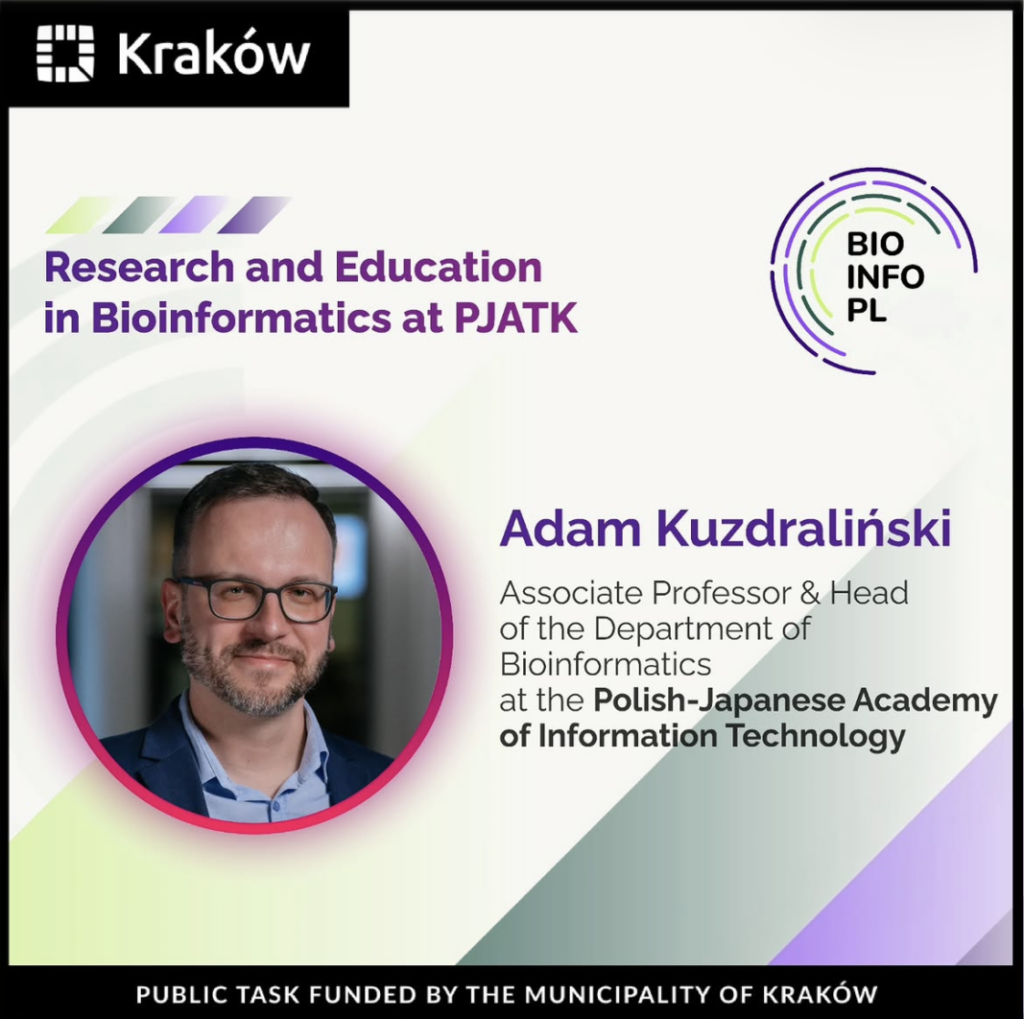
The bioinformatics faculty at PJAIT participates in the Polish scientific and industry communities. Dr hab. Kuzdraliński Dr hab. a professor PJAIT, presented the research and educational activities of the Department of Bioinformatics during Bioinformatics Community PL #5 in Kraków. Participation in such events fosters the exchange of knowledge, collaboration with industry professionals, and the further development of the program in line with current challenges in bioinformatics and the life sciences sector.
I wouldn't go so far as to say that "biotechnologists across Poland have written about this field." Based on this material, however, we can reliably say that:
field of study already well-established in the nationwide bioinformatics community and is attracting interest from a community of researchers, practitioners, and industry representatives.
Dr hab. Kuzdraliński, Dr hab. Prof. PJAIT, is the head of the Department of Bioinformatics and the developer of bioinformatics curriculum at the Polish-Japanese Academy of Information Technology in Warsaw.
He specializes in bioinformatics, molecular technologies, and DNA diagnostics. The application of artificial intelligence in the life sciences plays a particularly important role in his work. He combines his academic experience with entrepreneurship to develop solutions that include DNA-based technologies, nutritional supplements, and tools that support informed health management.
He is also actively involved in popularizing science, translating complex research topics into knowledge that is understandable and useful to a wide audience. As an external red-teaming expert, he has collaborated with OpenAI on testing advanced artificial intelligence models, including GPT-4o and GPT-5. He is currently also co-leading research with Anthropic Research (Claud).
His work focuses on developing practical innovations at the intersection of biotechnology, data analysis, artificial intelligence, and bioinformatics. It is precisely this interdisciplinary perspective that has formed the foundation of the bioinformatics programs he has developed at PJAIT.Expert profile at PJAIT
Associate Dean for Academic Affairs Prof. dr hab. Kazimierz Subieta Associate Dean for Teaching Dr. Pawel Lenkiewicz Associate Dean for Study Programs dr hab. Piotr Habela, Professor PJAIT
We use cookies to ensure the proper functioning of the website. We may also use cookies for analytical purposes in particular to match advertising content to your preferences. The use of analytical and functional cookies requires your consent. If you wish to accept all cookies, click "Accept all". If you do not consent to our use of non-essential cookies, click "Reject All." If you want to customize your consents, click "Manage cookies." Remember that you can withdraw any of your consents at any time by changing the settings you have chosen. For more information, see the Privacy Policy.
The use of cookies for the purposes indicated above is related to the processing of your personal data. For more information about our use of cookies and the processing of your personal data, including your rights, please see our Privacy Policy.
Below you can manage your preferences regarding the installation of analytical cookies on your device in connection with the use of our website. You can also review and learn which cookies are installed. For more information about the processing of your personal data and your rights, please see our Privacy Policy.
These cookies are essential to the operation of the site and cannot be disabled on our systems. They are usually set only in response to actions you perform that constitute a service request, such as setting privacy preferences, logging in or filling out forms. You can set your browser to block or alert you to these cookies, but some parts of the site will then not work. These cookies do not store any personally identifiable information.
These cookies allow us to count visits and traffic sources so we can measure and improve the performance of our site. They help us find out which pages are the most and which are the least popular and see how a visitor moves around the site. All information collected by these cookies is anonymous. If you don't allow these cookies, we won't know when you visited our site and won't be able to monitor its performance.
Files may be used by our Trusted Partners to track Users on websites. The purpose is to display ads tailored to the preferences of individual Users.