

Exhibition of Works by Part-Time Students NeMA


The results of a recent study by the prestigious Massachusetts Institute of Technology (MIT) reveal a dramatic gap between the promises of generative artificial intelligence and the reality of its deployments in companies. Despite investments of up to $30-40 billion, as many as 95% of corporate AI pilots end in spectacular failure.
The report "The GenAI Divide: State of AI in Business 2025," produced by MIT's NANDA project, paints a disturbing picture of AI implementations in companies. The results are clear: only 5% of pilot projects achieve rapid revenue growth, while the vast majority have no measurable impact on the bottom line.
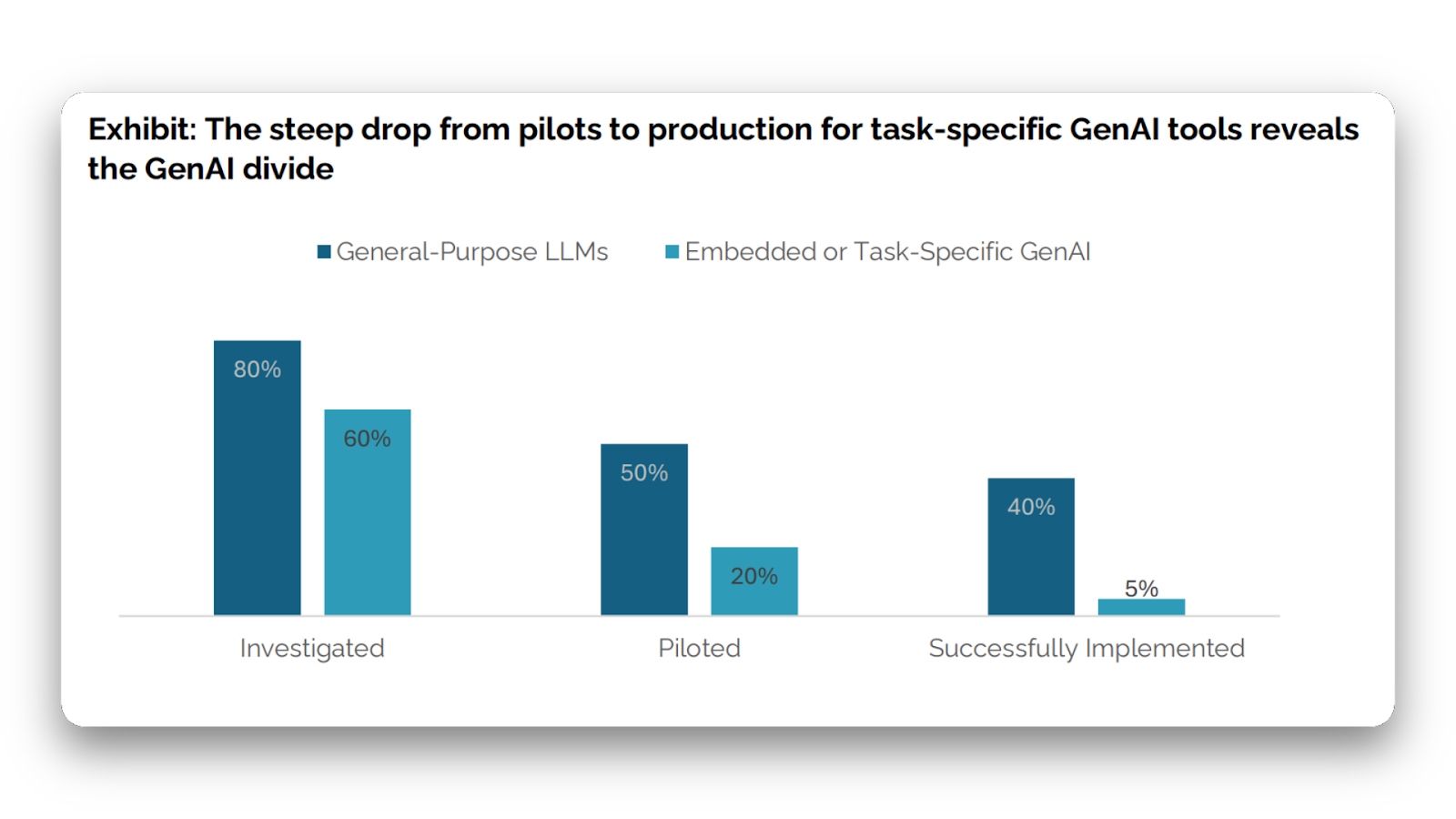
Let's take this chart apart. The report's creators analyzed exactly 300 such implementations in companies, and found that large general-purpose LLM language models like ChatGPT or Copilot are widely used, as 80% of the cases were considered for implementation, 50% lived to see piloting, and 40% ended in successful implementation. However, we are talking about applications that mainly increase individual employee productivity, without translating into financial results for the entire enterprise.
In the case of generative artificial intelligence, which is key here, embedded in the structure of enterprises and already intended for specific tasks to simplify company processes, it was already evaluated for implementation by only 60% of enterprises, of which 20% opted for a pilot, ending in successful implementation in only 5%.
Of course, successful implementations of GenAI tools are defined here as those that have resulted in a noticeable and lasting impact on productivity and/or financial performance.
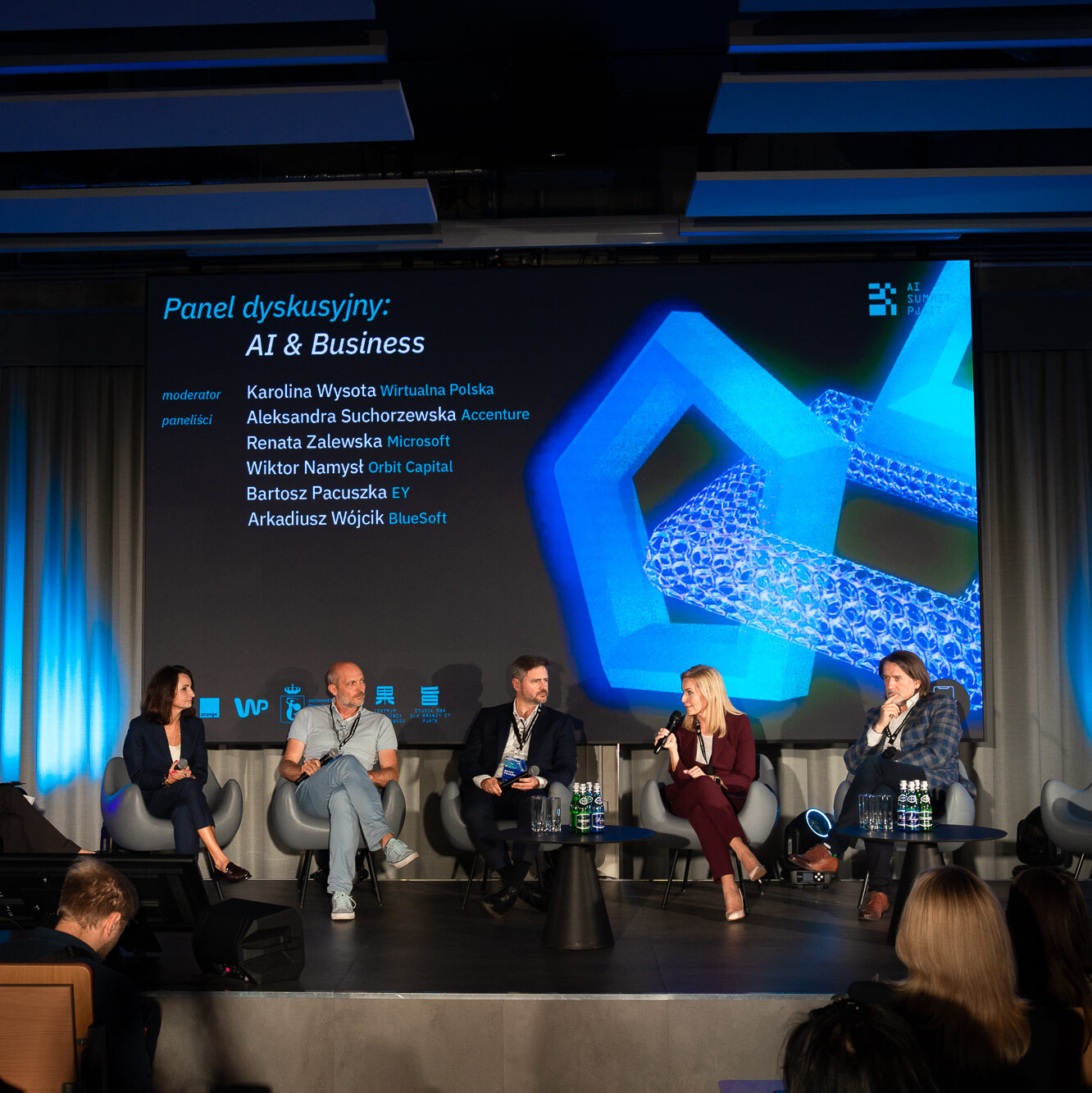
What are the reasons for these failed implementations? Aleksandra Suchorzewska of Accenture, during a panel discussion on AI in business at our recent AI Summit PJAIT 2025 conference, pointed to spotty implementations of artificial intelligence, without the often necessary reorganization of the entire enterprise structure in such a case, and without planning for a new working model and competitive advantage, as the main reasons for failed AI implementations.
There is also a not insignificant lack of ability to estimate the business benefits, appropriate metrics and set goals for AI implementation or implementations carried out without a clear value strategy.
The key recommendations identified here were: Developing AI strategies geared toward business benefits and treating AI as the main "driver" of the organization's transformation. Equally important are investments in preparing people and the operating model, and focusing on scalable implementations instead of spotty trials in which AI is merely an add-on rather than an integral part of individual processes.
Returning to the MIT report itself, according to the study's findings, a key problem in such deployments is the lack of ability of corporate GenAI systems to learn and adapt to changes in corporate processes. Most generative AI systems don't retain prior information, so they can't adapt to context and don't learn from incoming data. The result is poor integration into daily tasks and no lasting impact on organizational performance.
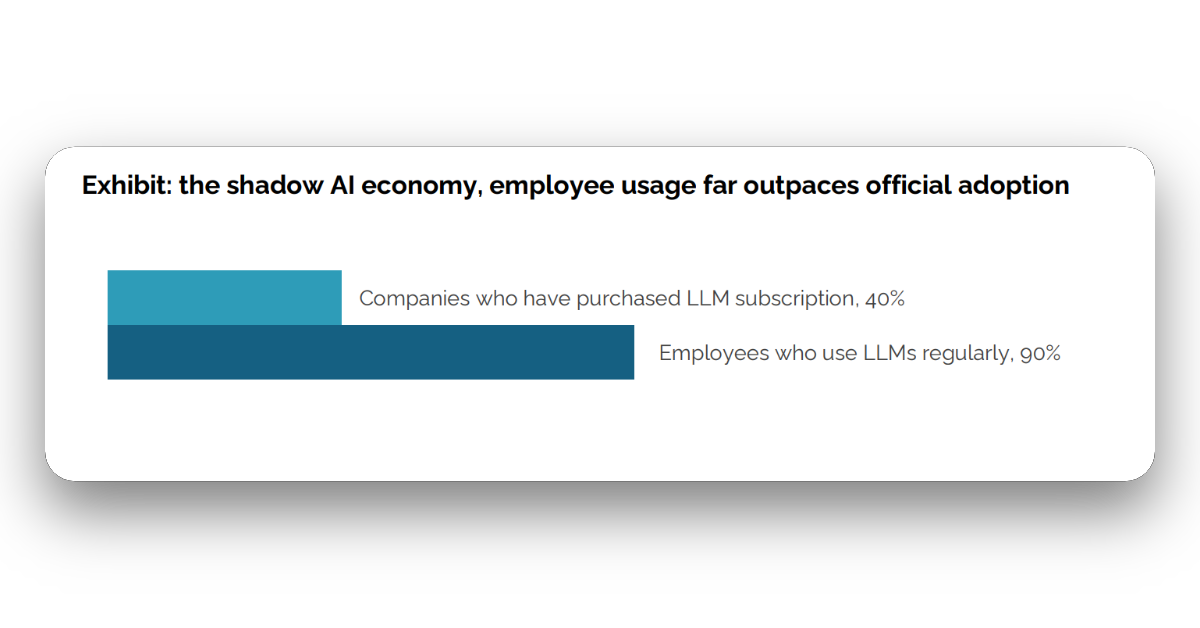
The problem can be clearly seen in the context of the "shadow AI economy" phenomenon , the use of personal AI tools by employees. MIT found that 9 out of 10 company employees regularly use their own ChatGPT accounts, Claude or other AI tools for daily business tasks, often without the knowledge of IT departments.
A striking contrast emerges here, as only 40% of companies have official LLM subscriptions, but still 90% of employees use AI at work. Many "shadow AI" users admit to multiple daily interactions with LLM as part of their regular workflow - with adoption often far exceeding their companies' approved AI initiatives, which remain in the pilot phase.
With only a few companies already taking advantage of and bridging this gap, analyzing this phenomenon by chiseling out those private tools and their uses by employees that bring them real value and implementing them later into corporate solutions.
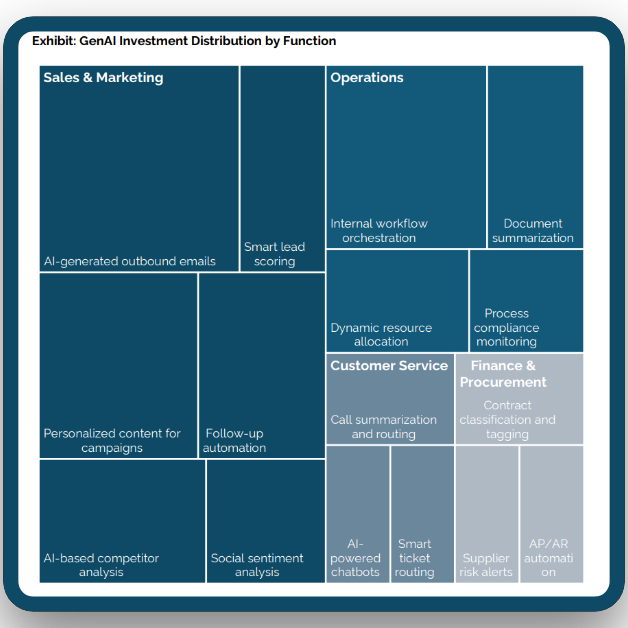
The report also reveals a significant mismatch in resource allocation. More than half of the budgets for generative AI go to sales and marketing departments, while the highest returns on investment (ROI) are in the area of automation in departments such as finance, HR and accounting.
Where does this come from? From a simple correlation, the results of investments in sales and marketing are more visible and measurable. In contrast, applying AI to finance, for example, offers more subtle benefits, including streamlined processes or accelerated month-end closing, which, while extremely important, is difficult to show in management interviews or investor reports.
The MIT study also reveals significant differences in effectiveness, depending on the AI implementation strategy. Companies buying off-the-shelf solutions from specialized vendors achieve success in 67% of cases. Meanwhile, building AI systems on their own succeeds in only a third of attempts. This is mainly for the reason that such specialized startups or integrators are quicker to adapt the model to the nuances of the organization's industry, which in turn avoids the cost of maintaining a team.
For managers responsible for AI strategies in their organizations, the MIT report is a useful resource, offering clear guidance on AI implementations in their companies. Certainly, the key here will be to choose solutions that not only generate content, but integrate with processes and evolve with the organization.
Companies wishing to avoid a fiasco should invest not only in AI tools themselves, but also in preparing managers to implement them effectively. Such preparation for effective management of digital transformation is provided by an MBA program for IT or a post-graduate degree in AI Leadership in Digital Transformation. It is also important to understand the technological underpinnings of AI, including the principles of large LLM language models, which are the foundation of most generative AI solutions.
The MIT report is a harsh assessment of the current state of AI implementation in business. The 95% failure rate is not a statistical anomaly, but a verdict on an outdated approach that treats AI as a simple technology to be purchased, rather than a transformative force to be integrated into the entire structure of an organization.
So what does the future look like in the context of the MIT survey results? Organizations that buy faster, teach smarter and deploy deeper will gain the advantage. The key here is to move away from "for PR" experiments to AI solutions with memory and a clear business model. Companies should invest in agent systems that gather knowledge about data, processes and decisions and can coordinate across the infrastructure.
This is because Agentic AI combines memory, for example, with the ability to autonomously invoke a series of processes in tools such as RAG, ERP or CRM, so that it operates within the current context of needed activities. Organizations that can deploy agents into their core processes the fastest and build the infrastructure to leverage this data cycle will create AI capabilities that competitors simply cannot copy.
According to the creators of the MIT report, there is little time left for this, the window for knowledge transfer in this area will close in the next 18 months, when the market will have already bound itself with long-term contracts with providers of relevant and proven solutions.