

Works by our graduate Julia Fijałkowska have advanced to the second round of the GRAFITEKA 2026 competition


Until recently, biology was mainly associated with laboratories, microscopes, and samples analyzed step by step. Today, it increasingly involves massive datasets, algorithms, statistical models, machine learning, and programming. This is where bioinformatics comes in—a field that combines the life sciences with computer science, mathematics, and data analysis.
Importantly, to begin with, this is not a niche field reserved for a small group of researchers. Bioinformatics helps us understand the human genome, analyze proteins, search for disease biomarkers, design new drugs, and advance personalized medicine. That is why it is increasingly referred to as one of the cornerstones of modern biology, biotechnology, and computer science in medicine.
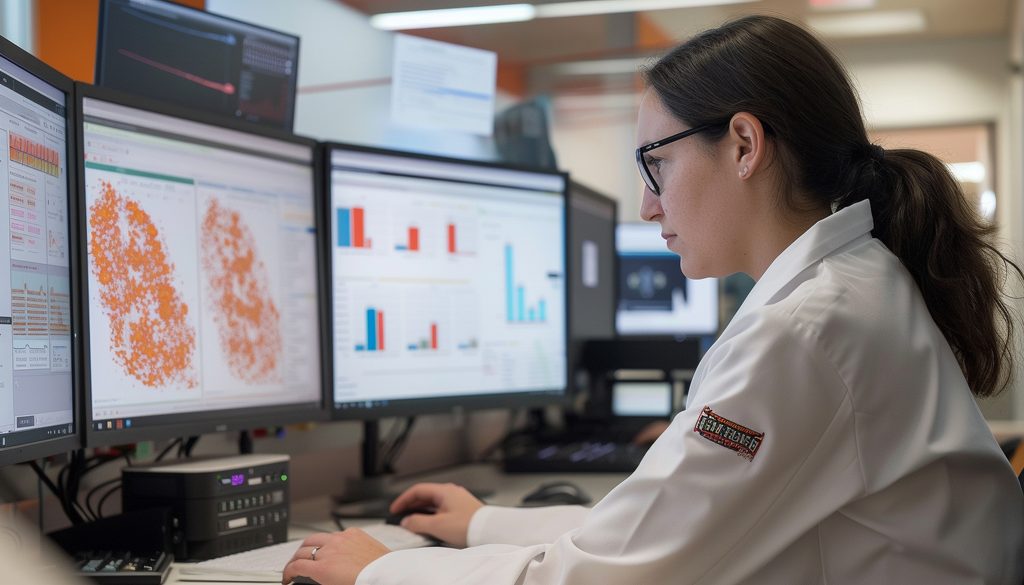
Simply put, bioinformatics involves processing and interpreting biological data using computational tools. This data may include DNA sequences, information on gene activity, protein structures, laboratory test results, clinical data, or sets of information derived from a wide variety of studies.
Of course, a bioinformatician doesn’t just run a program and wait for the results. Their work involves asking the right biological questions, selecting a computational method, preparing the data, verifying the quality of the results, and translating the numbers into a meaningful interpretation. This involves a combination of skills that, until recently, were often developed separately: biological knowledge, programming, statistics, databases, and analytical thinking.
A good example is DNA sequence analysis. The genome sequence alone is not enough if we cannot identify which segments are responsible for specific functions, where mutations might occur, and how a given change might affect health. Bioinformatics helps us move from raw data to hypotheses that can then be further tested in the laboratory or in clinical trials.
To understand what a bioinformatician does on a daily basis, it’s worth learning about a few related fields that provide them with data. One of the most important areas of bioinformatics is genomics, or the analysis of genomes. A genome can be compared to a massive instruction manual for how an organism functions—but one written in a way that cannot be effectively read without computational tools. Genomic analysis allows us to search for genetic variants, compare organisms, study susceptibility to diseases, and better understand the mechanisms of inheritance.
Another important area is proteomics, or the study of proteins. Proteins are responsible for many processes that take place within cells; therefore, their structure, function, and interactions with one another are of immense importance to medicine and pharmacy. Bioinformatic analysis of proteins can support drug design, predict the effectiveness of therapies, and identify processes that escape proper regulation in disease.
Added to this are further levels of data, such as transcriptomics, which studies gene activity, and epigenomics, which analyzes regulatory mechanisms without altering the DNA sequence itself; clinical data analysis, meanwhile, allows us to link molecular information to the course of a disease. Modern biology relies less and less on a single type of measurement. It increasingly requires the integration of multiple sources, and this is precisely the natural environment of bioinformatics.
Modern medicine is moving toward personalization. The goal is for diagnostic and therapeutic decisions to be tailored not only to the name of the disease, but also to the profile of the individual patient. This profile may include genetic data, laboratory test results, medical imaging, treatment history, lifestyle information, or data from health monitoring devices.
Without bioinformatics, this approach would be very difficult. The volume of information is too large to analyze solely by hand, and the relationships between data points are often too complex to be discerned through simple observation. Algorithms can help identify patterns, pinpoint likely disease mechanisms, and suggest directions for further research.
According to an analysis of longevity and the role of AI in medicine, it is precisely the ability to process vast amounts of genetic data and identify patterns invisible to the human eye that paves the way for early diagnosis and disease prevention. In both cases, the common denominator is computer science in medicine, based on biological data.
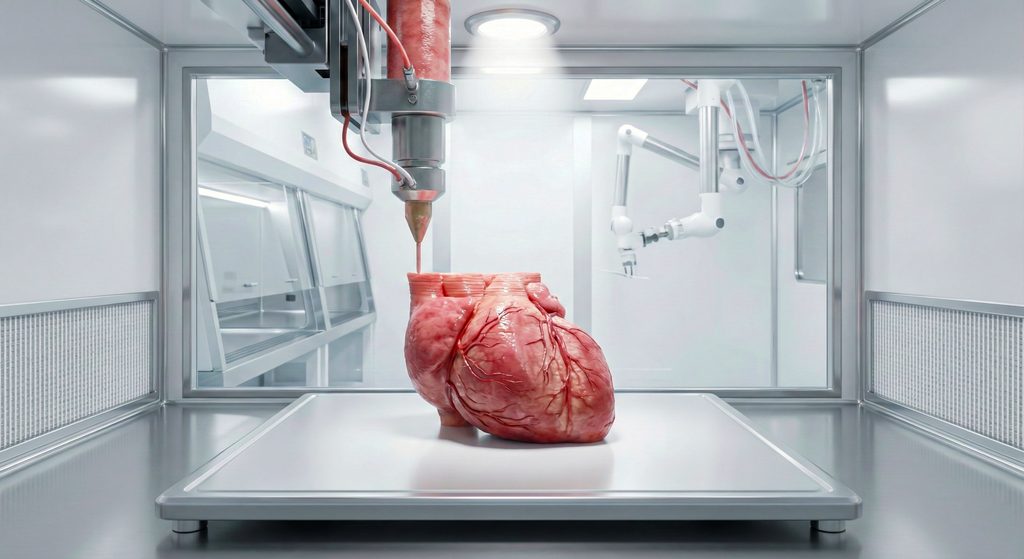
Bioinformatics also plays a role where medicine intersects with engineering. One example is 3D bioprinting, where printing biological structures requires not only materials and equipment, but also data in the form of medical images, tissue models, cell parameters, and simulations of the behavior of the structure being created.
In this context, bioinformatics helps analyze information about cells, predict biological compatibility, support the design of tissue models, and organize the data needed for further experiments. This is a good example of how the future of medicine will not be shaped by a single discipline. We will need teams in which a biologist, a physician, a computer scientist, an engineer, and a data specialist understand a common problem from different perspectives.
In bioinformatics, it is important to note that computer analysis does not replace biology, but rather enhances it. The laboratory generates data, and computational tools help us understand its significance. The results of the analysis can then be fed back to the lab as a specific hypothesis, a new research lead, or a suggestion for which experiment to conduct next.
This flow of information is particularly evident in drug research. Instead of testing random compounds through trial and error, researchers can use computer models to identify potential therapeutic targets, predict molecular interactions, and narrow down the number of experiments. This does not eliminate laboratory research, but it can shorten the path from an idea to a more promising therapeutic candidate.
A similar mechanism is at work in diagnostics. The analysis of molecular data can help identify mutations, classify disease subtypes, and search for biomarkers—that is, measurable signals associated with the development or progression of a disease. As a result, computer science in medicine is no longer merely a technical support tool but has become an integral part of the process of discovering new knowledge.
Bioinformatics is an interdisciplinary field, so there is no single, straightforward track path into this field. People with degrees in biology or biotechnology often develop digital skills, learn to program, and work with large datasets. Computer scientists, on the other hand, must understand the basics of molecular biology so that their tools can address real research questions.
Therefore, a solid understanding of Python or R, Linux systems, statistics, databases, version control, data visualization, and machine learning is helpful. It is also important to be able to work with sequence data, NGS (next-generation sequencing) results, biomolecular structures, and tools used in genomics and proteomics.
Communication is no less important. Bioinformaticians often work at the intersection of several teams, so they must explain their findings to people with varying backgrounds—biologists, doctors, programmers, data analysts, or R&D project managers. This is a profession for people who enjoy bridging worlds and aren’t afraid of questions that start with: “What exactly does this data mean?”
For those interested in bioinformatics, this degree program can be a way to organize their knowledge and acquire the practical skills needed in research, biotechnology, pharmacy, diagnostics, and AI projects related to medicine. It’s a particularly interesting choice for those who don’t want to limit themselves solely to laboratory work or solely to traditional programming.
The growing demand for specialists who combine expertise in biology and computer science has prompted our university to launch a master’s degree program in Bioinformatics. It is a two-year, on-campus field of study program taught in Polish, designed to serve as a bridge between the life sciences and modern technologies.
The curriculum atPJAIT is designed to gradually bring students up to the same level and avoid creating barriers that might discourage applicants from the start. Instead of assuming advanced technical knowledge, the academy program guides students from the ground up—including the fundamentals of bioinformatics, databases, and an introduction to biological data analysis. A key element here is a hands-on approach to tools such as Python, Linux, and data analysis environments, which are taught from the ground up and then systematically expanded upon. “Thanks to this, students transition smoothly from basic concepts to more advanced applications, such as DNA sequence analysis and elements of machine learning in computational biology,” says Prof. Adam Kuzdraliński, director of the Bioinformatics program.
People who are already working and want to retrain without quitting their jobs will also find postgraduate programs in bioinformatics atPJAIT . The program is aimed at graduates of natural sciences, biology, chemistry, or biotechnology, as well as IT specialists looking to enter the field of biological data analysis. It is particularly valued by those who prefer asynchronous work.
The bioinformatics program atPJAIT is designed as field of study for those who wish to expand their career opportunities. It is a natural track for graduates of biotechnology or medical fields who do not want to cut themselves off from their existing knowledge but wish to enter the field of modern technologies. For such individuals, bioinformatics can serve as a transition from traditional laboratory work to project-based—and often international—work. Many bioinformatics tasks can be performed remotely, working for research teams and companies from around the world,” notes Prof. Adam Kuzdraliński.
Students will learn, among other things, how to work in a Linux environment, programming in Python and R, containerization, relational database management, and the practical applications of bioinformatics in genomics, transcriptomics, and proteomics, including NGS data analysis and protein structure prediction. This is a good option for those who already have a degree and want to specialize in biological data analysis, working with programming tools, and the applications of bioinformatics in research, diagnostics, and industry.
It’s also worth noting that a master’s degree in bioinformatics opens doors not only to the biotechnology and pharmaceutical sectors, but also to the IT, data science, and AI industries, and many tasks can be performed remotely for employers in Boston, London, or Paris.
Biology and medicine are generating more and more data. DNA sequencing is faster than ever, large-scale experiments are becoming increasingly accessible, and healthcare systems are gradually collecting ever more detailed information about patients. However, data alone is not a breakthrough. A breakthrough begins when we are able to interpret it effectively.
Bioinformatics addresses precisely this challenge. It combines the precision of the biological sciences with the computational power of computer science and statistical methods that make it possible to distinguish random signals from genuine correlations. As a result, it can support earlier disease detection, more effective therapy design, the development of personalized medicine, and a better understanding of the processes occurring within living organisms.
Everything seems to indicate, then, that the importance of this field will continue to grow. Aging populations require increasingly precise diagnostics; the development of AI is multiplying the number of candidates for new drugs; and the automation of experiments and the digitization of medicine are generating ever-increasing amounts of data. The more data there is, the greater the need for people who can turn it into knowledge. Choosing bioinformatics means entering a world where code meets DNA, algorithms meet diagnostics, and data meets the real needs of patients. It is a world for curious, interdisciplinary individuals who are ready to learn the language increasingly spoken by modern biology and medicine.