

PJAIT Japanese Culture Department Alumni Reunion to Celebrate the 20th Anniversary


Every day, often without even realizing it, we leave traces of ourselves in the form of data. We order food through an app, check directions on a navigation app, watch a TV series on a VOD service, or “like” a friend’s post. Each of these activities captures a small fragment of our digital daily lives, which individually may seem trivial and insignificant to anyone, but on a massive scale creates a vast, valuable resource of information for companies, government agencies, and service providers.
The real challenge, however, is not simply collecting this data, but transforming it into meaningful patterns, insights, and business decisions—and that’s where data science comes in.
Simply put, data science is a field that combines scientific methods, statistics, programming, and industry-specific knowledge to draw the most useful conclusions from data. The term is sometimes translated as “the science of data,” but “research-based data analytics” better captures its essence. This is because it involves a systematic, evidence-based approach to reality as described by numbers.
Data science can be thought of as work at the intersection of three different worlds: numbers, technology, and business. On the one hand, we have the foundation of mathematics and statistics; on the other, the ability to programmatically manage and organize data; and third, an understanding of a specific area of a company’s operations, such as finance, marketing, or industry. Only someone who can navigate these three worlds with ease is capable of translating raw data into forecasts and recommendations that have a real impact on an organization’s decisions and results.
It’s also worth noting that data science is closely linked tobig data, because it is precisely these massive, rapidly growing datasets that serve as the “fuel” for the analyses and models created by data scientists. Big data provides the raw material, and data science is responsible for extracting patterns, forecasts, and recommendations from it that can be practically applied in business.
Now that we know what the field itself is, let’s take a look at the specialists who work in it. A data scientist—also known as a data researcher—is a specialist who collects, organizes, analyzes, and interprets data to build forecasts and scenarios that support business decisions based on the patterns hidden within it.
A good analogy here is that of a diagnostic physician, who makes a diagnosis based on a variety of test results and symptoms. A data analyst “examines” the condition of a company and its market environment, connects scattered signals, and translates numbers into specific recommendations that help predict trends and solve problems.
The day-to-day work of data scientists largely consists of “behind-the-scenes” data processing and follows a repetitive rhythm, even though no two projects are identical. It usually begins with “taming” the data—that is, understanding its structure, origin, and condition—because without this, it’s difficult to plan anything meaningful. Then comes the most tedious part: organizing the collected data, since real-world data is rarely complete and consistent, so removing errors, filling in gaps, and standardizing formats can take up the lion’s share of the project.
Only on a foundation prepared in this way does a researcher build mathematical models, drawing on algorithms and statistical methods designed to predict a specific phenomenon or behavior.
The final, equally important step is to translate the results into a clear message. Raw numbers alone won’t convince anyone, which is why data scientists present them in various forms of data visualization—from simple numbers and tables, through charts and infographics, all the way to interactive dashboards—so that even people outside the world of data can understand the implications of the analysis. It is precisely this ability to translate complexity into simple language that often determines whether an analytical project will actually influence the company’s future decisions.
It’s worth noting that this isn’t just a job “working with code.” As we mentioned earlier, a data scientist combines programming, mathematical, and business skills, but also analyzes the past to more accurately predict future trends and behaviors. It’s a role that acts as an intermediary between raw data and strategic management decisions, closely related to that ofa data analyst and a data engineer, who together form a team working with big data.
The theory only makes sense once we see how data science in business translates into concrete financial results and decisions. Companies use it, for example, to more accurately predict demand and avoid tying up capital in unnecessary inventory. Just as often, they use it to better understand customers; recommendation systems suggest future purchases, and models that detect churn signals help retain customers before they leave for the competition. Analytics also streamlines day-to-day operations, as continuous monitoring of processes facilitates a rapid response to deviations, and in the area of risk, it can detect threats or fraud attempts before they cause damage.
This is particularly evident in marketing, where data analysis helps divide customers into coherent segments and predict their future behavior based on how they have acted so far. The benefits, however, extend much further: well-executed analytics streamlines decision-making processes, boosts sales effectiveness, and supports team management. It’s no wonder, then, that data specialists are in high demand today—not only at tech companies, but also at banks, retail chains, marketing agencies, and healthcare facilities.
Contrary to popular belief, getting started in data analytics doesn’t mean you have to master dozens of technologies at once. The surest starting point is two programming languages. The first is SQL, which still appears most frequently in job posting requirements, and the second is Python, considered the essential tool for working with data and building models. This is no coincidence—Python has remained at the top of language popularity rankings for years and performs exceptionally well in data analysis, big data, and machine learning.
Over time, a broader set of tools develops around these fundamentals. Libraries such as NumPy, pandas, Matplotlib, and Scikit-learn aid in day-to-day analysis and model building, and when deep learning comes into play, frameworks like TensorFlow and PyTorch are added to the mix. Results still need to be presented in a readable format, so familiarity with visualization tools such as Power BI and Tableau is also necessary; and for truly large datasets—solutions from the world of big data, namely Apache Hadoop and Spark, as well as cloud platforms from Microsoft, Google, and Amazon.
However, the toolkit alone isn’t enough. Equally important—and often more difficult to learn—are soft skills: analytical thinking, the ability to ask the right questions, natural curiosity, and the ability to clearly explain results to others. Without them, even the most extensive technological arsenal isn’t enough to turn data into real decisions.
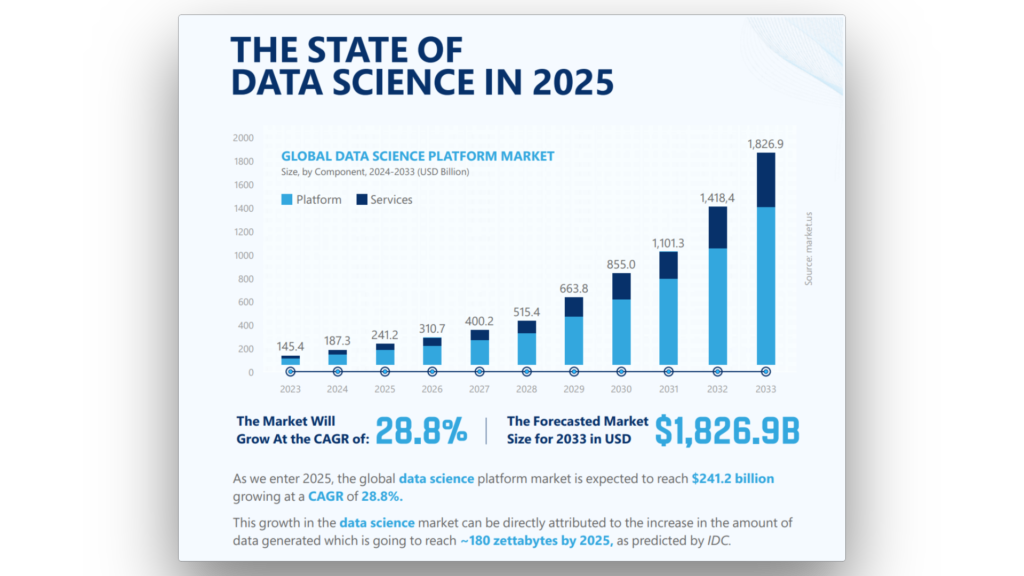
The numbers speak for themselves. Global data volume is growing exponentially and is estimated to have reached 180 zettabytes last year, which directly drives demand for specialists capable of managing this data (source: USDSI).
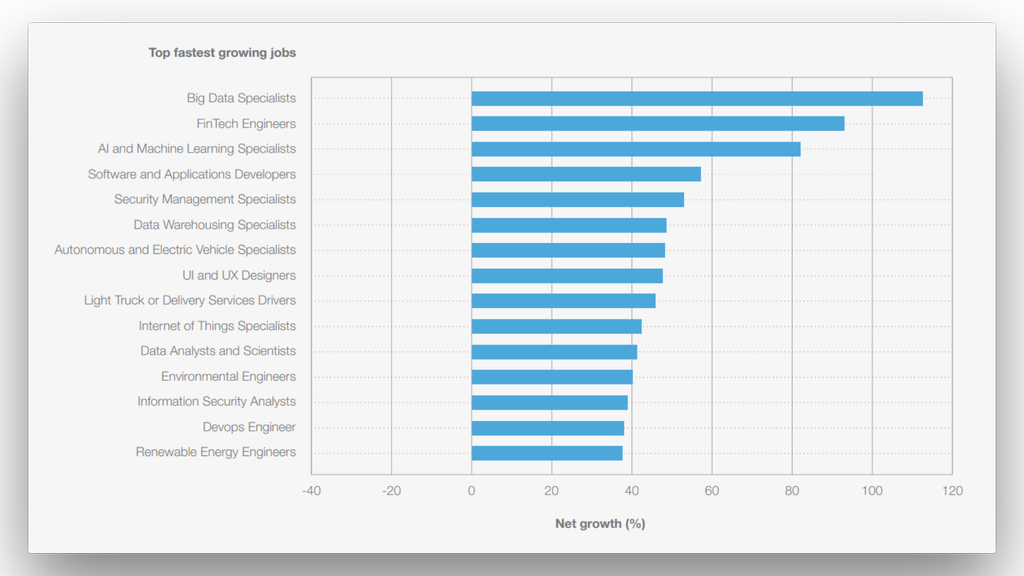
Furthermore, the World Economic Forum explicitly states that roles related to data science and analytics are among the fastest-growing in the job market.
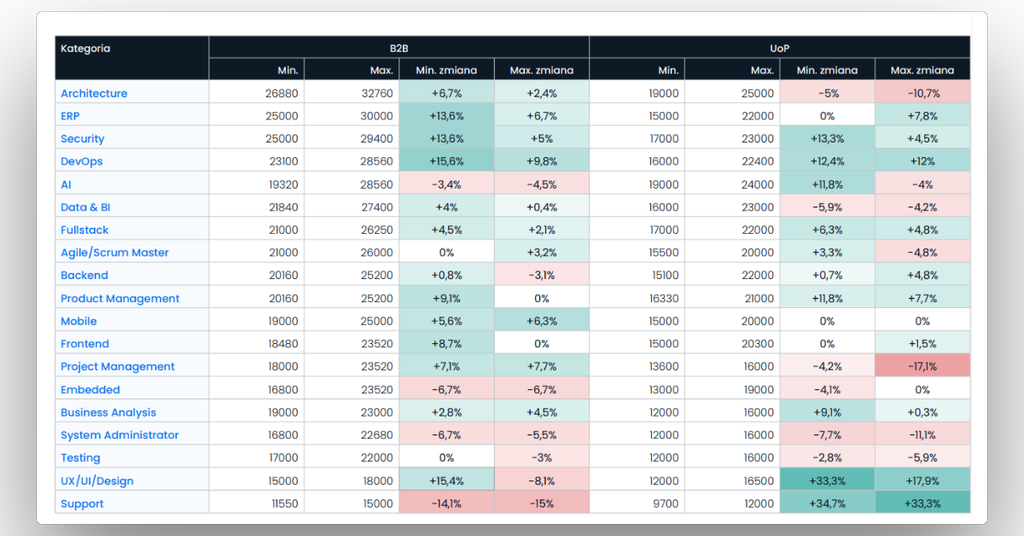
The Polish market also confirms this trend in terms of salaries. According to the latest No Fluff Jobs report,“IT Job Market 2025/2026,”in the Data & BI sector, the median salary range for B2B contracts is roughly between 21,800 and 27,400 PLN net per month, and for employment contracts—from 16,000 to 23,000 PLN gross.
Importantly, both ends of the salary range for this category have increased compared to last year—albeit slightly—but this shows that data-related work remains consistently and highly valued — specializations in the Data & BI field have ranked among the highest-paying roles in the Polish IT sector for years.
Since the prospects are so promising, a natural question arises: where to start? A solid foundation is an education in computer science, which provides knowledge of programming, mathematics, and statistics—the building blocks without which it is difficult to understand advanced techniques in data analysis and artificial intelligence.
This training is providedby field of study ,computer science , andPJAIT. The engineering program emphasizes hands-on experience, projects, labs, and internships conducted in collaboration with leading technology companies, and the curriculum covers key areas of data analytics, including statistics, artificial intelligence, intelligent systems, and data science. In addition, the Faculty of Computer Science has a separate Department of Intelligent Systems and Data Science, where students learn about the latest AI tools and how to solve real-world computer science problems.
For those who already have a degree and want to specialize in working with data, a postgraduate program in Big Data—Big Data Engineering—is a good choice. The program guides students through the entire data processing workflow—from processing and analysis to the practical application of results—and covers data science tools, programming in Python and R, the NumPy, SciPy, Matplotlib, and Scikit-learn libraries, the Apache (Hadoop, Spark), and the connections between big data and machine learning. The program is designed for both computer scientists and programmers, as well as professionals from other fields who wish to utilize data in their professional work.
Data science is one of the most important fields in today’s digital economy, as it combines statistics, programming, and business knowledge to turn raw data into accurate predictions and better decisions. A data scientist not only builds models but also asks the right questions and tells the “story of the data” in a way that is understandable to the business.
Combined with the growing volume of data and attractive salaries, this means that data analytics will remain one of the most promising careers in the coming years. And since everything starts with a solid foundation—namely, mathematics, programming, and analytical thinking—a well-chosen computer science degree or graduate program is the surest path to making a name for yourself in this field.