Space at the Intersection of Science, Art, and Technology – Exhibition Opening During Gaia Day at PJAIT


Your first program doesn't have to be a complex application; to start with, a simple tool that compares measurement results, flags unusual values, or organizes information from several files will suffice. Python, a language used in data analysis and web development, can be used for such tasks. How do you go from learning the basics to solving problems on your own?
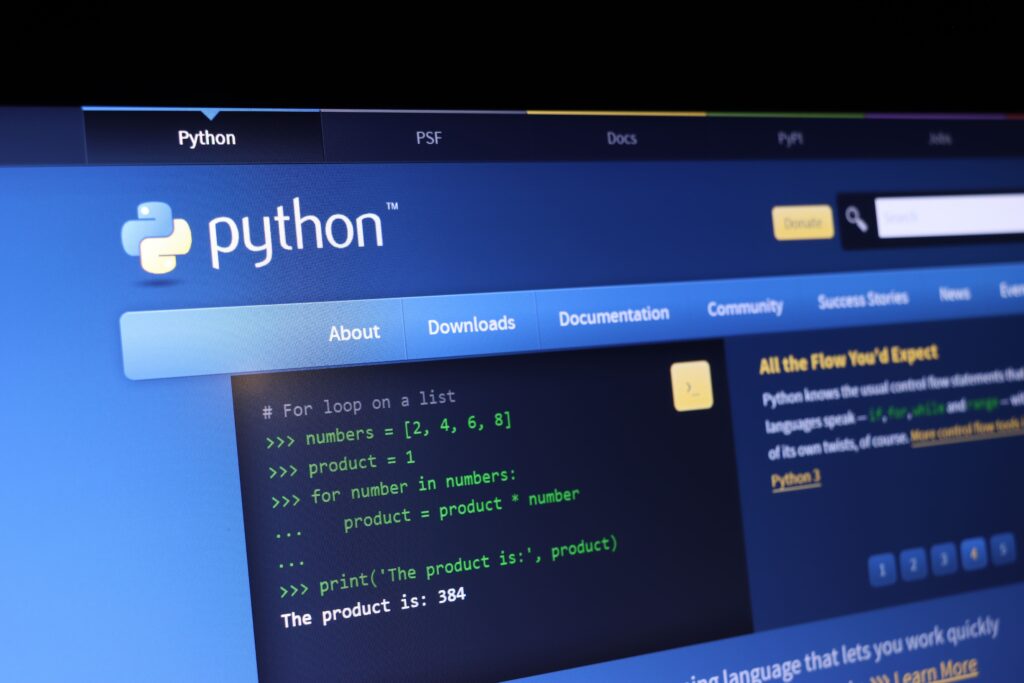
To start, let’s answer the basic question: What is Python? It is a general-purpose programming language that allows you to create both small scripts and more complex applications. Its applications include, among others, scientific computing, information processing, web service backends, and tools that support developers’ work. So you don’t have to choose a specific specialization right away to start learning it.
The Python language is distinguished by its concise syntax, dynamic typing, and the availability of an interpreter and standard library for the most important operating systems. An interpreter is an environment that executes written instructions, while the standard library provides ready-made tools for, among other things, handling files, dates, and data in JSON format. This makes things easier, as it means you don’t have to build every function needed for a given project from scratch.
However, a simple code does not mean you can stop thinking about whether the solution is correct. A program may run without displaying an error message but still produce an incorrect result. That is why, even during the first exercises, you should ask yourself two questions: What exactly do we want to calculate, and how will we know that the result is correct?
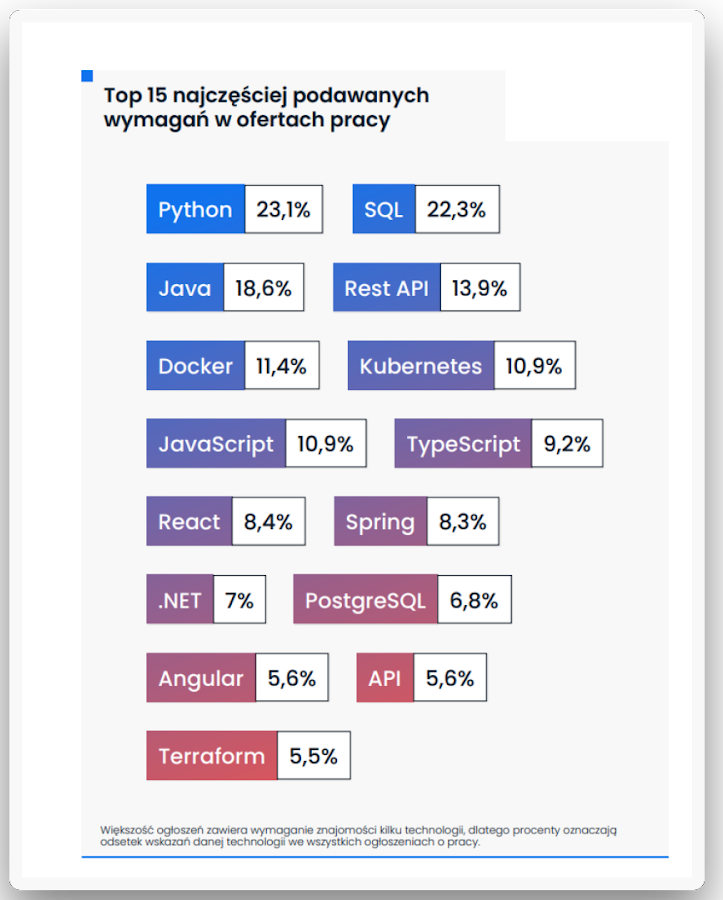
One reason to choose this technology is its versatility across various fields, from data processing to web applications and machine learning. The importance of this technology is also highlighted by the No Fluff Jobs report on the IT market in Poland for 2025/2026 —according to the data cited in the report, Python was listed as a requirement in as many as 23.1% of the job postings analyzed. Let’s not forget, either, that it’s also one ofthe most popular programming languages. For a beginner, this is a good reason to start from the basics and decide on the next steps after a few experiments of your own. It’s also a good idea to figure out whether you find more satisfaction in organizing information, automating tasks, or building services for other users.
Additional libraries and frameworks—that is, ready-made components and structures that facilitate software development—play a significant role here. Pandas supports data analysis, while Django and Flask are used to develop web applications. However, there’s no need to learn many of these tools at once when you’re just starting out. It makes more sense to first understand the task and then choose the appropriate extension for it.
For example, if the goal is to compare a dozen or so temperature readings, you can start with a simple list of values. Only then, as the next step, can you load the entire file, create a graph, and compare the results from different days. In this way, each new skill addresses a specific need and immediately finds a practical application.
To start, let’s choose the currently supported version of Python 3 and a code editor. Our first goal should be to run a small file, change the value it contains, and check the result again. It’s best to treat setting up the environment as preparation for the exercises, rather than a separate project that requires learning all the available settings.
A good next step would be to choose a single course that starts from the basics and systematically supplement it with additional materials. It’s important to distinguish between a course for someone who has never programmed before and an introduction to a new language. The official Python tutorial assumes prior knowledge of basic programming concepts. For complete beginners, a better starting point might be Charles Severance’s book*Python for Everybody*—in it, the author introduces basic programming concepts and demonstrates their application through examples, without assuming any prior experience in writing code.
It will be helpful for your future learning to set a small, specific goal right away—for example, writing a program that takes several measurement results and displays a summary of them. It doesn’t need to have a window, user accounts, or an internet connection just yet. A program like this area allows you to focus on the logic rather than getting distracted by elements that aren’t necessary at this stage.
The first stage of learning should cover values and their types, conditional statements, loops, functions, and basic data structures. It’s best to learn these in small doses and apply them immediately through exercises. The sequence of such learning might look like this:
Of course, this isn't about flawlessly recalling definitions from memory. A better test would be to independently answer the question of why a list is needed in one place and a condition in another. In Python, programming must be approached from the very beginning as the process of mapping out a workflow—where the information comes from, how it is checked, and what is to be produced from it.
It’s good practice to alternate between writing code and anticipating how it will behave. Before running a short code snippet, you can write down the expected result and then compare it with the actual outcome. If there is a discrepancy, the goal is not to immediately rewrite the solution, but to find the first place where your assumptions diverge from the actual execution.
It will also be helpful to keep a log of problems. In addition to noting only the correct version, it’s a good idea to record what was wrong, how you identified it, and what scenario revealed the error. In a measurement project, this could be a missing threshold value or a file containing a header instead of a number.
When learning a specific programming language, it’s important to remember that the answer to the question of how to become a programmer goes beyond mastering syntax—it also involves developing independence, testing, and creating your own solutions. So it’s worth adopting a simple rule: an exercise isn’t complete just because you’ve obtained a result; it’s complete only when you can explain why that particular result was produced.
A similar approach works well when using AI assistants. Instead of immediately asking them to write an entire application, you can ask questions to test their understanding of the code or have them suggest scenarios that are worth testing. You should then evaluate each suggestion on your own, and not treat the generated code snippet as a mastered skill until you can explain and modify it.
Once you’ve built your first project, you can choose field of study for further exercises. For those interested in data analysis, this might involve comparing larger datasets and preparing clear summaries, while for those who prefer practical applications, it could mean developing a service that collects and shares information. It’s better to focus on one area through a specific task than to start several advanced courses at once.
In addition to practicing syntax, it’s also a good idea to plan a project that you can run, test, and present to someone else. The description should explain the application’s purpose, how the data is prepared, known limitations, andarea of your own work. Even a simple tool for analyzing measurements can serve as a good basis for discussing design decisions, provided its author understands every stage of the processing.
Learning Python is best viewed as one component of a broader IT education, rather than a substitute for knowledge of the entire field. At the same time, it’s a good idea to consider enrolling in the “computer science ” program atPJAIT, which combines theoretical knowledge with projects, lab work, and the development of teamwork skills. Our academy program places particular emphasis on the importance of mathematics—including algebra, calculus, and statistics—in the context of advanced artificial intelligence methods. This perspective allows students to move beyond simply asking how to write a program and begin to ask why a particular method is suitable for a given problem.
For graduates considering further study directly related to this language, a good option is the postgraduate program “Python – Artificial Intelligence Programming,” whose curriculum covers data processing and visualization, working with files and SQL databases, as well as machine learning and deep learning models. The program covers, among other things, the NumPy, Pandas, Scikit-learn, and Keras libraries, with an emphasis on the mathematical foundations for making informed method selection. This is afield of study of professional development for those who want to combine coding with an understanding of how to analyze data.
A good start doesn't require an ambitious declaration about your future specialization. All you need is a clearly defined task, a few designs you're familiar with, and a willingness to test your own assumptions. Additional tools should be introduced only once you know what they'll be used for.
In turn, progress in learning is best measured by increasing independence—that is, the ability to identify errors, predict outcomes, and justify the chosen method. Python can serve as a starting point, while personal projects and structured learning provide a way to gradually broaden this perspective. However, the best test at the beginning will be not so much passing another course as completing a small, understandable program from start to finish.