




Exhibition of Works by Part-Time Students NeMA


A Full Stack Developer is a programmer who can work on both the user-facing aspects of an application and the technical infrastructure that makes the digital product actually work. In practice, this means combining front-end, back-end, and database skills, and often also a foundation in DevOps, testing, and architecture design.
Does that sound broad? Because that’s exactly what this role entails. Of course, this doesn’t mean that a Full Stack Developer has to be the top expert in every technology used in a project right away, but they should understand the entire flow of the application—from clicking a button, through communication with the API, all the way to saving data to the database and deploying changes to the server. That’s why this role is for people who like to look at the product as a whole, rather than just through the lens of a single piece of code.
Simply put, a Full Stack Developer is a programmer who works on both sides of an application. On one hand, they handle the front-end layer, or the user interface. On the other hand, they develop the back-end—that is, the business logic, database communication, authorization, integrations, and processes that the user typically doesn’t see.
While a front-end developer is responsible for the application’s appearance and interactions, and a back-end developer handles the mechanisms running “behind the scenes,” a full-stack developer bridges these two worlds. They can build a form in a browser, connect it to an API, design a data structure, handle server-side validation, and ensure that the entire system is maintainable.
It’s worth keeping in mind that “full stack” doesn’t mean “one person who does everything.” In mature teams, a full-stack developer still collaborates with designers, testers, architects, cloud specialists, analysts, and product managers. Their advantage, however, is that they understand the interdependencies between the different layers of the system and can more quickly assess how a change in one place will affect the rest of the product.
The term "full stack" refers to the entire technology stack used to build an application. This stack includes not only the programming language, but also frameworks, libraries, a database, a server, deployment tools, a version control system, a testing environment, and external services.
In a web application, a typical full-stack area might include:
However, not every company requires a Full Stack Developer to use the exact same set of tools. In a startup, a single person can realistically build most features from start to finish. In a large organization, a Full Stack Developer more often works in a specific area of the product, but thanks to their broad perspective, they collaborate more easily with other specialists and resolve issues at the front-end/back-end interface more quickly.
The day-to-day work of a full-stack developer depends on the product, the size of the team, and the developer’s level of experience. It looks different at a software house, different at a SaaS company, and different still at a corporation developing a large internal system—but there are a few recurring areas worth mentioning here.
A full-stack developer is often responsible for the entire workflow of a feature. A simple example is a user creating an account in an app. The developer must create a registration form for this purpose, add data validation, connect the form tothe API, save the data to the database, ensure password security, handle error messages, and verify that the entire process works correctly on various devices.
This kind of work requires not only knowledge of programming language syntax, but also an understanding of the product’s logic. A good full-stack developer immediately asks questions such as: What data is really needed? What happens if a password is incorrect? How can the form be protected against abuse? How quickly will the user receive a response? And how will the system behave under a heavier load?
One of the most important aspects of this role is the ability to diagnose problems that extend beyond a single layer of the application. An error may appear to be an interface issue, but its root cause is often a poorly designed API. Slow page loading can result from both a heavy front end and a suboptimal database query.
A Full Stack Developer can trace the entire process and pinpoint where something stops working. This makes them particularly valuable on teams that develop products quickly, iteratively, and with frequent changes in requirements.
Although “full stack” is often associated with broad technical expertise, this role also requires strong communication skills. A developer must discuss usability with designers, error scenarios with testers, priorities with product managers, and technical limitations with the business side.
In practice, this means that “writing code” itself is only part of the job. A full-stack developer participates in sprint planning, code reviews, estimations, bug analysis, discussions about architecture, and documenting technical decisions.
There is no single, universal list of technologies that guarantees a full-stack role. The market is changing rapidly, and companies use a variety of technology stacks. However, there are some fundamentals that are hard to avoid.
To start with, it’s a good idea to gain a solid grasp of HTML, CSS, and one ofthe most popular programming languages —JavaScript—since these form the foundation for working with web applications. The next natural step is to learn TypeScript and one popular front-end framework, such as React, Angular, or Vue.
On the back end, Node.js, Java, Python, C#, or PHP are all good choices. For someone following the JavaScript/TypeScript path, Node.js is a popular choice because it allows you to use a single language on both sides of the application. This does not mean, however, that every full-stack developer must limit themselves to JavaScript. In many companies, stacks based on Java, .NET, Python, or PHP are still very prevalent.
On top of that, there are databases. A full-stack developer should understand the difference between relational and non-relational databases, be able to write SQL queries, design simple data models, and know how to avoid common performance issues. Knowledge of Git, the command line, the basics of Docker, environment configuration, and data security best practices is also helpful.
The difference primarily concerns the scope of responsibility. A front-end developer focuses on how the application looks and how the user interacts with it. A back-end developer is responsible for server-side logic, data, integrations, and processes that run outside the browser. A full-stack developer combines both areas, which is why they should understand the consequences of decisions made on either side.
So, can we assume that a full-stack developer can always replace these two specialists? Not necessarily; in larger teams, experts in front-end, back-end, cloud, security, and databases are still needed. Full-stack development, however, shines where flexibility, rapid prototyping, the ability to independently implement features, and good communication between application layers are key.
It’s safe to say that a Full Stack Developer is a good “interpreter” between the different parts of a system. They understand why an interface needs data in a specific format, why an API should behave predictably, why a database cannot be designed haphazardly, and why a seemingly minor change to a form may require modifications to the server-side logic.
The best path to becoming a full-stack developer starts with a solid foundation. It may be tempting to jump right into frameworks, ready-made templates, and AI tools, but without an understanding of the basics, it’s hard to grow in a meaningful way. To start, it’s worth learning how the internet works, as well as the HTTP protocol, browsers, servers, databases, authentication, and application architecture.
A good study plan might be track , broken down into several steps:
Those who want to build a career in IT starting from a more systematic foundation may want to consider studying computer science at our university. field of study computer science atPJAIT allows students to develop the skills needed in various programming specializations, not just in a single technology.
The engineering degree program at our university is based on a broad area curriculum, ranging from programming, algorithms, and databases to software engineering, computer networks, and multimedia, and culminating in team projects and, most importantly, opportunities to choose a specialization later on.
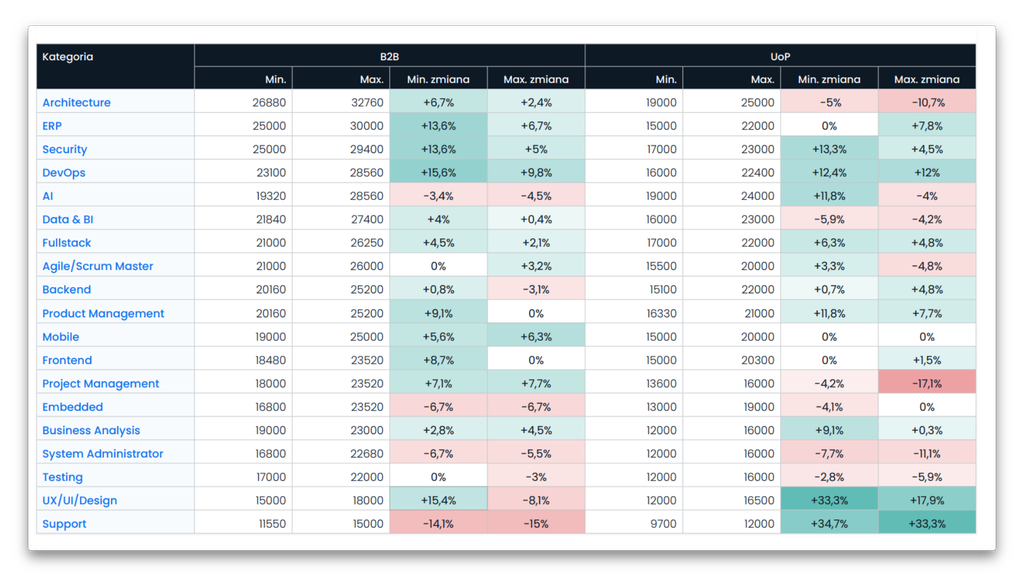
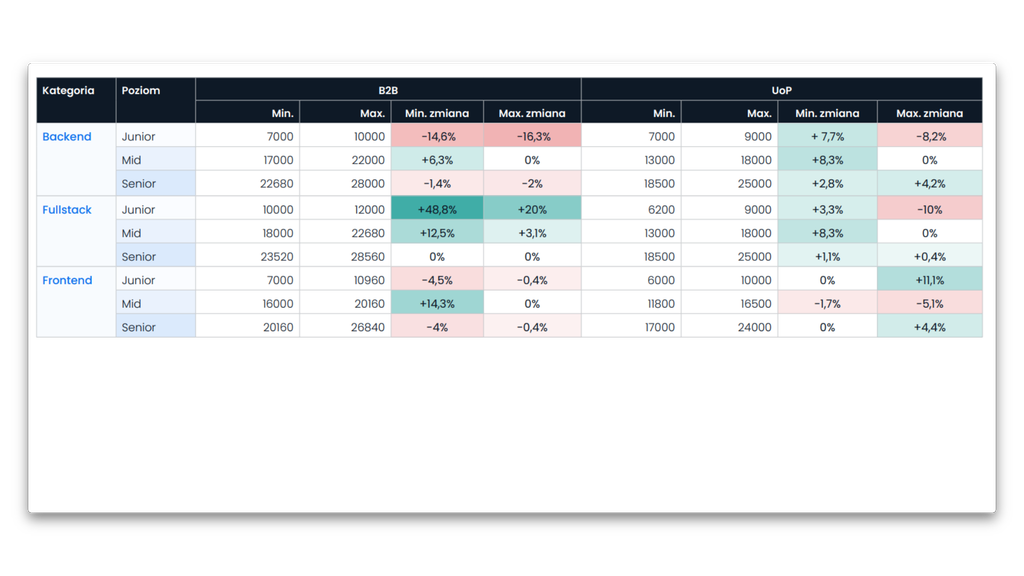
Full-Stack Developer is among the highest-paying positions in the IT industry. According to the latest No Fluff Jobs report,“IT Job Market 2025/2026,”the median salary range for Full Stack positions was 21,000–26,250 PLN net + VAT for B2B contracts and 17,000–22,000 PLN gross for employment contracts. This level is higher than in the Frontend category and comparable to the salaries offered in many back-end positions.
However, these figures should be interpreted with caution. The No Fluff Jobs report is based on salary ranges from job postings—that is, it reflects what employers are offering, not every actual salary paid in the market. At the same time, unlike experience levels, these data clearly show that full technical independence is highly valued.
The difference between a junior and a senior developer isn't just a matter of the number of years listed on a resume, but primarily stems from their responsibility for architecture, code quality, design decisions, and anticipating the consequences of changes.
The same report also indicates that the IT market in 2025 saw a significant rebound in the number of job postings, and competition for each position decreased. In the Full-Stack category, the decline in the average number of applications per job posting was among the largest. This is good news for candidates, but it doesn’t mean entering the profession will be easy. Companies still prefer to hire people who can quickly deliver value and don’t require constant guidance on every task.
Full-stack development can be an attractive career path, but it isn't always the best first step. For a beginner, area this role can be overwhelming, because you have to learn front-end development, server-side logic, databases, tools, and design best practices all at once. That’s why many people start with either front-end or back-end development and only later expand their skills.
On the other hand, learning full-stack development from the very beginning has one major advantage—it shows you more quickly how a complete application works. Even a simple project with a form, an API, and a database teaches you more about the real-world software development process than practicing individual technology components on your own.
For people who enjoy seeing the big picture, solving problems, and independently managing projects from concept to implementation, becoming a Full Stack Developer can be a great career path.
This role requires extensive knowledge, practical experience, and continuous professional development, but it also offers a great deal of career flexibility. A Full Stack Developer can work at a startup, a software house, a product company, or a corporation—or develop their own projects. For those who want to build applications from start to finish and understand what happens on both sides of the screen, this is one of the most versatile career paths in programming.