


Works by students from the " PJAIT " at the International Puppet Theater and Animated Film Festival “A Puppet Is a Person, Too”


The visual layer of every website, every application we use every day – this is the result of a front-end developer's work. It's a profession that combines technical programming skills with a keen eye for aesthetics and user-centric thinking.
A front-end developer is responsible for the part of an application or website that the user sees and interacts with. They translate graphic design, business requirements, and usability principles into a functioning interface: buttons, forms, animations, mobile views, a customer dashboard, and an online shopping cart.
To simplify this to a specific question – what does front end actually mean? The simplest way to put it is this: it's the layer of a digital product closest to humans.
In practice, the answer to the question "What is a front-end developer?" goes beyond just coding the website's appearance. A front-end developer must understand application structure, API communication, state management, component testing, the basics of technical SEO, and the principles of responsiveness. The larger the project, the more likely they are to collaborate with back-end developers, UX designers, testers, product managers, and analysts.
It's worth remembering that front-end development isn't an "easier version of programming." It's a distinct specialization that requires combining engineering precision with attention to interface detail. Therefore, those planning to enter IT should consider this path a full-fledged one. field of study development, not a transitional stage before another role.
This position combines programming, user experience design, and understanding browser functionality. A good front-end developer not only writes code but also ensures website speed, accessibility, the security of basic interactions, and the user-friendliness of the product across devices. This is a job for those who enjoy seeing the results of their work but also want to develop solid technical skills.
In short, a front-end developer is a specialist who creates user interfaces for web applications. They primarily work with HTML, CSS, and JavaScript, and in modern projects, also with TypeScript and frameworks like React, Angular, and Vue. Their job is to ensure that the designer's design works quickly, predictably, and in line with the user's needs in the browser.
area Duties vary by company, product, and experience level, but a front-end developer's day-to-day work typically involves several repetitive areas. The most important of these is creating and developing application views. The developer builds components, connects them to data, handles errors, refines forms, and ensures that the user can complete the task smoothly.
Another important element is collaboration with UX/UI designers. Front-end designers often assess whether a given idea can be implemented within a reasonable timeframe, suggest technical constraints, and seek ways to maintain the product's visual consistency.
So, if someone is interested in this area, a natural complement to technical competences can be the postgraduate studies in UX Design at PJAIT , which develop thinking about user needs, service design and solution testing.
The third area is technical quality. Front-end developers analyze website performance, improve accessibility for screen reader users, write tests, perform code reviews, and ensure the application functions correctly across various browsers. Working with AI tools, automation, design systems, and CI/CD processes is also increasingly important in modern teams.
As mentioned earlier, the foundations remain HTML, CSS, and JavaScript. HTML is responsible for the content structure, CSS for the appearance and layout, and JavaScript for the interaction logic. Without a solid foundation in these three technologies, it's difficult to use frameworks consciously.
Even though many courses attempt to jump straight into React, this isn't the right path. A solid understanding of HTML, CSS, and JavaScript makes it easier to later learn frameworks like React, Angular, or Vue, as it allows for a better understanding of what's happening beneath the surface of pre-built tools. React is a common choice for startups, software houses, and SaaS products, while Angular is used in larger organizations and enterprise systems, and Vue is valued by teams looking for a simpler entry level.
Added to this are tools like Git, npm, Vite, Next.js, testing libraries, REST API, GraphQL and the basics of working with the terminal, and the next step is TypeScript, which helps write more secure and maintainable code.
Job market reports show that JavaScript, TypeScript, and React are among the technologies that regularly appear in employer requirements and provide the highest-paying positions in the IT industry . This is a good sign for those planning a front-end career – knowledge of the JavaScript ecosystem still has practical recruitment value.
It is worth regularly monitoring the rankings of the most popular programming languages , because the technological landscape is changing extremely quickly and new tools can quickly gain market importance.
The most sensible path starts with IT fundamentals. You need to understand how the internet works, what a client and server are, how a browser retrieves resources, what the HTTP protocol means, how forms work, and why data structure matters. Without this, you can create simple views, but it's harder to develop larger applications and solve real-world design problems.
A good choice for people who want to build a career from scratch is computer science studies. field of study computer science at PJAIT allows you to develop programming, mathematical and design competencies needed in many IT specializations, not only in front-end – education at our university covers various modes and provides space for building technical foundations for further specialization.
In parallel, it's worth building a portfolio. Initially, these might include simple pages, calculators, forms, clones of selected views, or small applications that retrieve data from an API. Over time, the portfolio should showcase not only aesthetics but also code quality: components, project structure, tests, responsiveness, accessibility, and a description of technical decisions.
Juniors have it harder today than they did a few years ago. The 2025/2026 No Fluff Jobs report shows that junior positions represented a small portion of the market, and employers were clearly more likely to seek experienced candidates. This doesn't mean a closed path, but it does require more preparation than just a degree. A portfolio resembling a real job is the most valuable. Instead of ten simple landing pages, it's better to prepare two or three applications that demonstrate login, form validation, error handling, API integration, a mobile version, and a sensible component structure. A recruiter or technical lead will more quickly recognize a candidate who can explain why they chose a given solution and how they overcame limitations.
It's also worth practicing communication. Front-end developers often explain complex issues to non-technical users, such as why a particular animation effect will slow down a page, why the contrast of a button needs to be improved, or why implementing a seemingly minor change requires a component redesign. Therefore, soft skills will undoubtedly help you join the team more quickly.
The phrase "front-end developer salary" is one of the most frequently searched phrases by those considering this specialization. The answer depends on experience, contract type, city, product scale, and technology. However, recent reports show that front-end development remains a stable paying specialization, although competition for entry-level positions is strong.
According to the No Fluff Jobs report “ IT Labor Market 2025/2026 ”, the median range in offers for the Frontend category was PLN 18,480–23,520 net + VAT for B2B and PLN 15,000–20,300 gross for an employment contract.
In terms of experience, it looked as follows: junior frontend could count on earnings of PLN 7,000–10,960 net + VAT on B2B or PLN 6,000–10,000 gross on the basis of the Employment Agreement, mid 16,000–20,160 net + VAT on B2B or PLN 11,800–16,500 gross on the basis of the Employment Agreement, and senior 20,160–26,840 net + VAT on B2B or PLN 17,000–24,000 gross on the basis of the Employment Agreement.
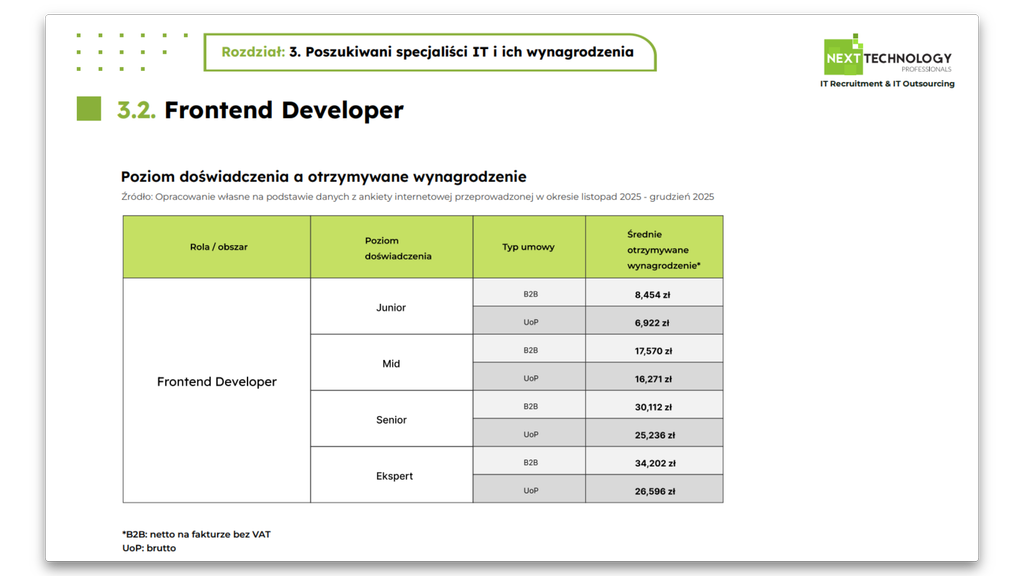
This year's second report, " IT Labor Market in Poland in 2026, " from Next Technology Professionals, is based on a survey of IT employees and shows average salaries. For Front-End Developers, the average salary is PLN 8,454 gross for B2B and PLN 6,922 gross for a junior-level UoP; PLN 17,570 gross for B2B and PLN 16,271 gross for a mid-level UoP; PLN 30,112 gross for B2B and PLN 25,236 gross for a senior-level UoP; and PLN 34,202 gross for B2B and PLN 26,596 gross for an expert-level UoP.
As you can see, a beginner front-end developer typically earns significantly less than a senior, but the difference isn't just years of experience. Independence, the ability to work with application architecture, familiarity with team tools, quality of communication, and the ability to deliver features without constant handholding are also key factors.
Yes, but it is not anymore track "Easy entry" into the industry. The IT market is showing signs of recovery after a period of slowdown, but companies are becoming more cautious about hiring beginners. At the same time, digital products still need specialists who can design fast, accessible, and user-friendly interfaces.
The front-end is evolving along with the entire market. TypeScript, full-stack frameworks, performance optimization, digital accessibility, integration with AI tools, and the ability to collaborate with businesses are becoming increasingly important. Someone who stops at simply assembling layouts may struggle to grow. However, someone who understands the product, the user, and the technology still has many opportunities in this area – all it takes is a little consistency, practice, and a willingness to constantly learn.