Exhibition of Works by Part-Time Students NeMA


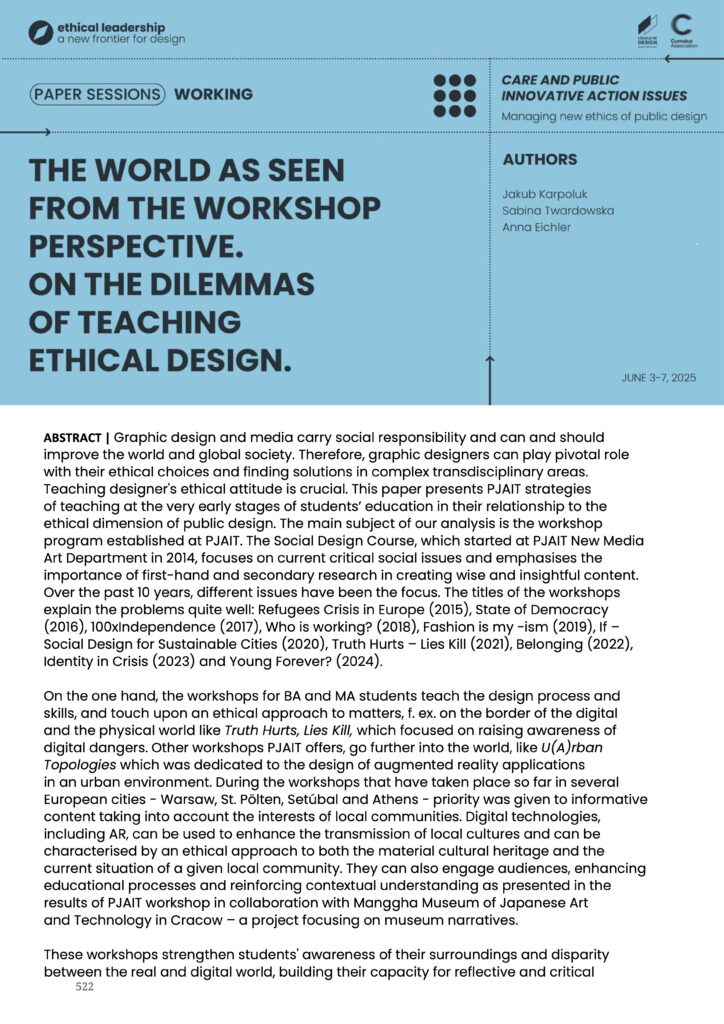
The article "The World Seen from a Workshop Perspective: On the Dilemmas of Teaching Ethical Design " by Dr. Anna Eichler, Dr. Sabina Twardowska, andDr. Jakub Karpoluk was published in France by the Cumulus Global Association in a collection titled *Ethical Leadership: A New Frontier for Design*. The volume was edited by renowned French academics Frédéric Degouzon and Jade Gagnapain. The volume is a collection of articles presented at the conference “Ethical Leadership. A New Frontier for Design,” which took place between June 3 and 7, 2025, atL’École de design Nantes Atlantique in France.
The article summarizes reflections and experiences in teaching ethical design through the Social Design Course (SDC) workshops and augmented reality (AR) projects. The authors emphasize that designers have a real impact on society, which is why ethical education should begin as early as possible. The SDC, which has been running continuously since 2014 as part of the PJAIT New Media Arts Department’s program, introduces first-year students to the design and research process and encourages reflection on current social issues. Each year, the workshops focus on a different topic, including the refugee crisis, democracy, misinformation, identity, and an aging society. Students work based on articles, expert lectures, and their own research, creating pro-social illustrations and animations. The program fosters ethical awareness, critical thinking, and teamwork skills.
The second part of the article discusses AR projects implemented in urban and museum spaces. The authors point out that AR can support local communities and serve to educate the public about cultural heritage. Examples include projects U(A)rban Topologies , implemented between 2022 and 2025 in several European cities (St. Pölten, Warsaw, Setúbal, and Athens), and AR Museum, implemented in 2025 at the Manggha Museum of Japanese Art and Technology in Kraków (KPO grant). The authors emphasize the importance of an anthropological approach, “rooting” AR content in the local cultural context, and the designer’s responsibility. The authors argue thatintroducing students early and consistently to the ethical, social, and cultural aspects of design leads to the development of conscious, socially responsible creators capable of positively influencing the world around them.