
Halloween 2026 atPJAIT!


In recent years, artificial intelligence has been associated mainly with chatbots—tools that primarily answer questions. Now, however, we are entering a new phase in which AI not only responds but also takes action. AI agents are systems capable of autonomously accomplishing complex tasks without the need for a series of individual commands.
It is precisely this change that is making the term “AI agent” one of the most frequently mentioned topics in discussions about the future of technology, business, and work. Companies around the world are investing in this technology because they see in it something that no previous system has offered: the ability to assign a task and receive the finished result, rather than having to be involved in every intermediate step.
Before we get into the details, it’s worth answering a fundamental question: What exactly are AI agents? Simply put, an AI agent is a software system that independently perceives its environment, makes decisions, and takes actions toward a specified goal without needing step-by-step instructions. It is software that does not passively wait for the next command, but determines on its own what needs to be done to achieve the desired result.
What are AI agents in practice? They are programs that combine four key characteristics:
The most common misconception regarding this concept is equating an AI agent with a chatbot. A chatbot receives a query and returns a response; thus, its role ends when the text is displayed. An AI agent, on the other hand, treats every piece of information as part of a broader process aimed at achieving a goal. If an obstacle blocks progress, the agent looks for an alternative path rather than simply reporting a failure.
It’s also worth noting that AI agents—just like artificial intelligence in general—are no longer just a laboratory curiosity. They are entering our daily lives and work, changing the way we perform tasks, communicate, and make decisions.
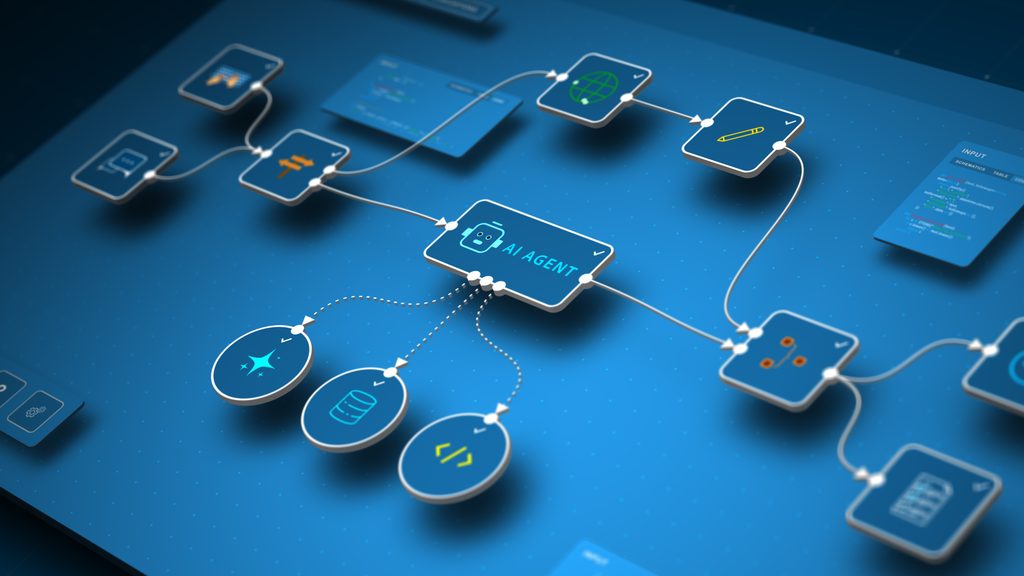
To understand how an AI agent works, we need to look at its internal architecture. At the technical heart of most modern agents is a large language model (LLM) —a system capable of understanding and generating natural language. It is these LLMs that serve as the agent’s engine, enabling it to interpret commands, plan actions, and evaluate results. But the model itself is only the foundation; the agent’s entire architecture is much more than just the ability to generate text.
Added to this are the tool management layer (the agent knows when and how to invoke an external system), the memory layer (the agent knows what it has already done and what it needs), and the orchestration layer (the agent knows the order in which to execute subsequent steps). Only these three elements, together with the LLM, form what can be called a true AI agent.
The AI agent’s operation is based on a cyclical loop of four stages, the first of which is perception. At this stage, the agent receives input data from its environment. This can include text messages, internet search results, data from external APIs, files, or signals from monitoring systems. In other words, the agent gathers all the information it needs to make subsequent decisions and take further action.
The next stage is reasoning, in which the agent analyzes the collected data in the context of the specified goal. In doing so, it uses a language model as its “brain” to plan subsequent steps and prioritize them. It can break down complex tasks into smaller parts and actively make decisions, rather than merely reacting to stimuli. It then moves on to action—that is, carrying out the planned activities—and can send emails, generate reports, modify files, query databases, or communicate with other systems. It is at this stage that real changes occur in the environment.
The final element of the loop is the feedback loop, which allows the agent to evaluate the results of its actions. If the outcome does not meet expectations, the agent adjusts its strategy, tests other approaches, or employs new tools. This ability to adapt sets it apart from simple automation systems.
Memory also plays a key role—both short-term memory, which encompasses the context of the current session, and long-term memory, which consists of a lasting store of knowledge. This allows the agent to take previous interactions into account, such as by remembering issues the user has reported in the past.
This question comes up very often, and rightly so, because the line between these concepts can be blurred in software manufacturers’ marketing messages. However, the key differences can be precisely summarized in several aspects:
| Dimension | AI Assistant | AI Agent |
| Mode of Operation | Reactive – responds to commands | Proactive – works independently to achieve a goal |
| Autonomy | Low – requires constant supervision | Wysoka – works without step-by-step instructions |
| Memory | Limited to the session | Sustainable, long-term |
| Planning | None or very limited | Multi-stage, with the option to make adjustments |
| External Tools | Rare or none | It integrates with APIs, databases, and systems |
| Examples | ChatGPT in chat mode, Google Assistant (Gemini) | Devin, AutoGPT, GitHub Copilot Workspace |
Thus, AI assistants are ideal for simple, one-time tasks that require an immediate response. AI agents prove to be indispensable whenever a task is complex, involves multiple steps, requires integration with external systems, or should proceed without the user’s constant involvement.
The question “What is an AI agent?” is best illustrated through the lens of specific applications. Today, agents are used in nearly every industry, handling everything from routine administrative tasks to complex analytical processes.
In the corporate environment, AI agents are taking over tasks that previously consumed hours of analysts’ and specialists’ time. In customer service, an agent integrated with the CRM system automatically classifies inquiries, retrieves customer history, resolves common issues, and escalates only those cases that require human intervention. This reduces service time, lightens the workload on employees, and improves customer satisfaction, especially outside of business hours.
In marketing and sales, agents analyze customer behavior data, segment the customer base, personalize offers, and plan campaign schedules, as well as autonomously test different communication variants, selecting those with higher conversion rates. In finance, on the other hand, agents monitor transactions in real time, detect anomalies that may indicate fraud, automatically generate reports, and conduct preliminary credit risk analysis.
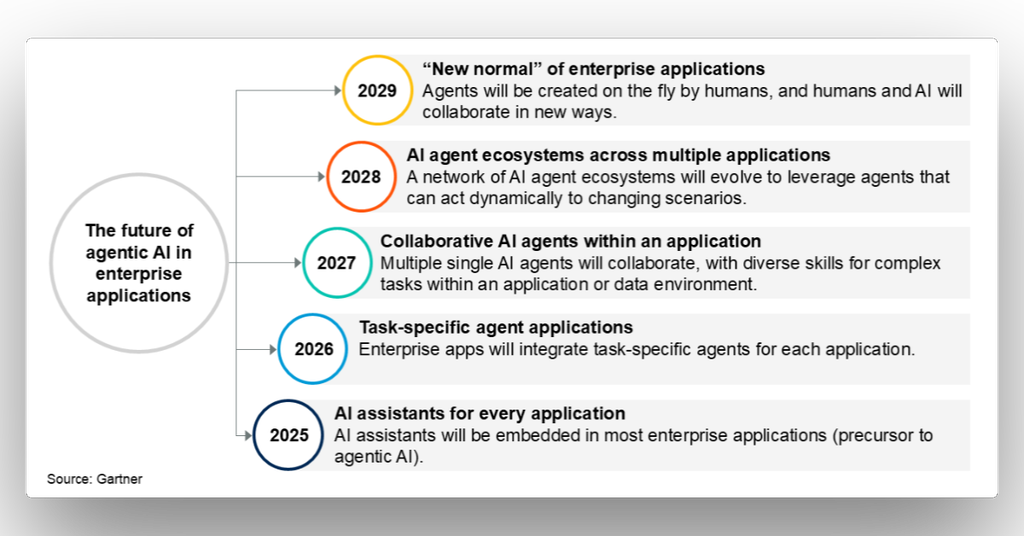
According to Gartner’s forecasts, by the end of this year, as many as 40% of enterprise applications will use AI agents as an integral part of their processes. This pace of adoption is comparable only to the adoption of cloud computing at the beginning of the last decade.
In IT, the most spectacular example is Devin, a programming agent capable of independently analyzing errors in code, suggesting fixes, testing solutions, and creating pull requests. IT agents can also monitor server infrastructure and respond to incidents before a problem escalates to the point where human intervention is required.
In the healthcare sector, agents assist doctors in analyzing test results, help plan treatment paths, and manage medical records. They relieve staff of tedious administrative tasks, allowing them to focus on direct patient care.
The HR agent, in turn, searches candidate databases, conducts an initial screening of submitted resumes against the job requirements, schedules interviews, and automatically responds to candidates’ inquiries about the status of the recruitment process. This significantly reduces the time needed to fill a vacancy, especially when there are a large number of applications.
In e-commerce and logistics, agents automatically manage inventory levels, optimize delivery routes, and dynamically update prices in response to changing demand and competitors’ actions. In an industry where margins are low and customer expectations are high, this type of decision automation can be the key to a competitive advantage.
A single AI agent is already a powerful tool. But the true power lies in multi-agent systems, where many specialized agents work together to carry out complex projects that none of them could complete on its own.
In this setup, one agent acts as an orchestrator, takes on the overall goal, breaks it down into subtasks, and delegates them to specialized sub-agents. Each sub-agent has its own area of expertise and the appropriate tools. Communication between agents takes place in a structured manner, which minimizes the risk of errors resulting from ambiguity.
It’s already easy to imagine a marketing agent managing an entire campaign for a new product, in which an analytics agent collects and processes data on the target audience, identifying key segments, a copywriter creates content tailored to each audience segment, a graphic designer prepares visual materials consistent with the brand identity, and a publishing agent prepares a schedule and implements the campaign across various distribution channels.
This entire process runs autonomously; humans set the goal and approve the results, but do not need to be involved in every stage of implementation. Multi-agent systems represent a new model of work organization, in which AI does not simply assist humans with individual tasks, but takes over entire business processes.
The growing demand for AI specialists is making expertise in this field one of the most sought-after skills in the job market. Whether you’re interested in the technical or managerial side of things, there are proven paths to acquiring the necessary skills.
Computer science programs—such as the engineering degree program at our university, offered by theFaculty of Computer Science , which has been in operation since 1994—provide a solid foundation in programming, algorithms, and the basics of machine learning. This program is the largest and oldest inPJAIT and has already educated more than 5,500 students.
The department comprises specialized departments, including the Department of Foundations of Artificial Intelligence, Bioinformatics and AI Applications, and Intelligent Systems and Data Science. The degree program in “computer science ” atPJAIT places a strong emphasis on practical experience, including labs, internships with technology partners, and collaboration with leading IT companies. Graduates of this program go directly into environments where large-scale AI systems are designed and implemented.
For those who want to quickly and practically enter the world of AI, the postgraduate program “Python – Artificial Intelligence Programming” atPJAIT is an excellent option. The program covers Python, machine learning, deep learning, and data analysis—exactly the elements needed to create AI agents based on popular frameworks.
The program is offered on an asynchronous basis, which allows students to balance their studies with their professional work. It’s the perfect solution for those who want to change careers or expand their technical skills without giving up their current responsibilities.
Technical knowledge is one thing, but implementing AI agents in a company is, above all, an organizational and strategic challenge. Who will set the goals? Who will ensure data security? Who will manage the change? Managers and leaders who want to effectively guide their organizations through AI transformation can benefit from the postgraduate program “AI Leader in Digital Transformation.”
The program consists of approximately 160 hours of instruction and is designed for managers and specialists who want to learn how to implement AI solutions within the context of specific organizations, from strategic planning to change management, impact assessment, and building a “data-driven” culture.
AI agents represent a qualitative leap in the capabilities of artificial intelligence systems. Their autonomy, long-term memory, ability to engage in multi-step planning, and deep integration with external systems mean that AI agents are beginning to tangibly change the way companies and institutions carry out their processes.
AI agents are already serving customers, writing code, analyzing financial transactions, managing medical records, and recruiting employees—and by the end of 2026, they will become an integral part of a significant portion of corporate applications. So it’s safe to say that this is already a reality that is taking shape right before our eyes.