
A promotional event for the book *Facet w zadymie. Przyjaciele* by Marcin Giżycki, followed by a screening of selected animated films by Prof. Marcin Giżycki.


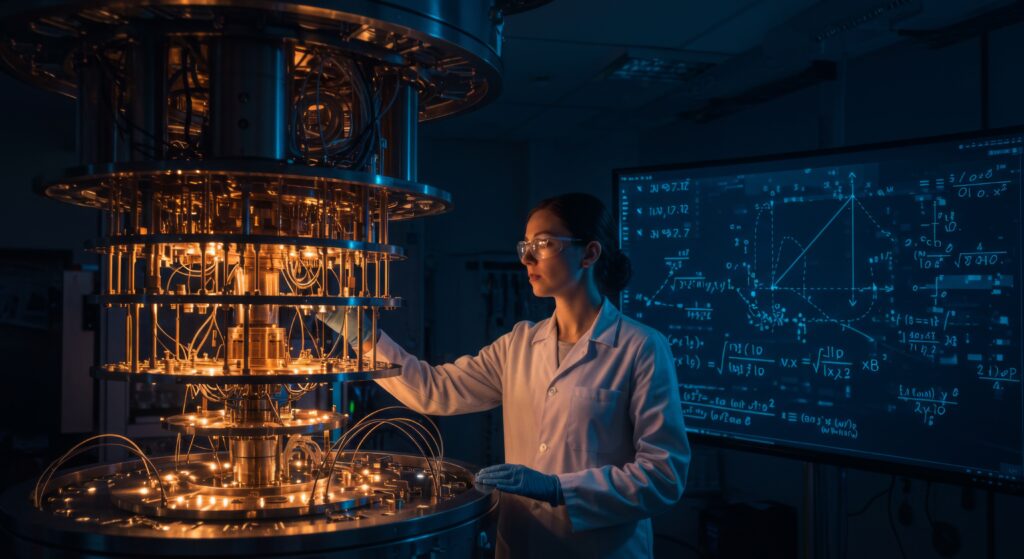
Quantum computers are increasingly rarely portrayed solely as a physics experiment. It is already possible to use them viathe cloud, run algorithms on actual processors, and build systems that combine quantum computing with classical HPC infrastructure. This isn’t yet the beginning of a mass revolution, but it is a clear shift. We’re moving beyond questions about whether the technology will work to exploring tasks where it can deliver an economic advantage.
However, this same technology has a flip side. A sufficiently large and error-resistant quantum computer could compromise the security of popular public-key cryptography systems. Not only would communication channels and digital signatures be at risk, but also some of the mechanisms used by banks, government agencies, infrastructure operators, and blockchain networks.
Of course, this doesn't mean that we'll wake up tomorrow to a world without secure payments. It does mean, however, that a long-term overhaul of the foundations of digital security has begun.
In a classical computer, information is stored in bits, which take on a value of either 0 or 1. A quantum computer operates using qubits (quantum bits), utilizing, among other things, superposition and entanglement. This does not mean that every operation automatically becomes faster. A computational advantage can only arise for specific classes of problems and when using appropriate algorithms.
That is why a quantum computer will not replace a laptop, a server, or a data center. A hybrid model is more likely, in which a classical processor will manage the entire task, and the quantum chip will handle a selected portion of the calculations for which its architecture may prove advantageous.
This is the model currently being developed by hardware, cloud computing, and software providers. IBM expects that the first examples of quantum advantage will be demonstrated as early as this year in combination with classical HPC systems, but this should be viewed as a goal outlined in the company’s development plan rather than a widely recognized breakthrough.
At the same time, IBM announced an investment of more than $10 billion over five years and continued work on a large, fault-tolerant computer scheduled for 2029.
This clearly illustrates the nature of the current commercialization. Today, companies are buying not so much a ready-made “quantum advantage” as access to equipment, expertise, experiments, and intellectual property. They simply want to be prepared for the moment when the next generations of devices begin to solve useful problems better or more cheaply than the best classical methods.
The most natural area of application is the simulation of quantum systems, including, among others, molecules and materials. Their behavior is governed by quantum mechanics, and accurately modeling them on a classical computer quickly becomes very costly as the complexity of the system under study increases.
The goal is to shorten the path from hypothesis to experiment. Better models could help in the future with the design of catalysts, drugs, fertilizers, materials with new properties, and batteries with greater capacity. In one of their early projects, IBM and Daimler used a small quantum processor to study selected molecules related to lithium-sulfur battery chemistry. The project’s authors noted, however, that the device did not yet outperform classical computers, and the result was a research milestone, not a ready-made method for designing batteries.
The second “ field of study ” is optimization. Global logistics, production planning, route selection, and scheduling create vast spaces of possible solutions. Quantum and quantum-inspired algorithms can help search through these possibilities, but here, too, there is still no universal proof of an advantage on an industrial scale. Today, companies are comparing quantum, classical, and hybrid methods, rather than assuming in advance that the new technology must win out.
The third area encompasses risk analysis, machine learning, and the modeling of complex processes. The potential here is great, but it is easy to confuse a demonstration on a carefully selected problem with a solution ready for implementation. Therefore, a company’s most important competency today is not the purchase of a specific processor, but the ability to identify tasks in which the limitations of classical computing impose a real business cost.
Quantum decoherence (interaction with the environment) remains the biggest obstacle. The quantum state is very fragile, and environmental disturbances lead to errors in calculations. Today’s processors have anywhere from tens to thousands of physical qubits, but the number alone does not yet indicate how large or precise a task can be performed on them. Error correction is of key importance.
In the target machine, many imperfect physical qubits are intended to collectively form a much more stable logical qubit. The overhead can be enormous, so a device capable of attacking modern cryptography will likely require hundreds of thousands or millions of physical qubits, depending on the architecture, the quality of the hardware, and the error-correcting code used.
That is precisely why the sensational claim that a quantum computer will break current ciphers “in a few seconds” is misleading. One of the estimates from the *Quantum Journal* for RSA-2048—which is still widely cited today—spoke of approximately 20 million noisily qubits and eight hours of operation for a hypothetical machine. While more recent optimizations do lower the resource estimates, they still apply to devices far more powerful than those currently available, and the result depends on numerous engineering assumptions.
The source of the problem is Shor's algorithm. On a sufficiently large quantum computer, it allows for the efficient solving of mathematical problems on which RSA, Diffie-Hellman, and elliptic curve cryptography are based. These mechanisms are used for key exchange, authentication, and creating digital signatures.
However, not every cipher becomes useless. Symmetric cryptography, such as AES, is much more resistant to known quantum attacks. Grover’s algorithm can theoretically speed up the search of the key space, but it does not lead to as drastic a breakdown in security as Shor’s algorithm does in the case of public-key cryptography.
The claim that “quantum computers will break blockchain”also requires clarification. A quantum computer does not automatically erase transaction history or take over every network. However, it can threaten digital signatures, which confirm the right to dispose of assets. The extent of the risk depends on the design of the protocol in question, the method of disclosing public keys, the signature algorithm used, and the ability to implement updates. For blockchain networks, migration can be particularly difficult because it requires coordination of changes among many independent participants.
The uncertainty surrounding the date when a cryptographically significant quantum computer will be built does not eliminate the threat. An attacker could intercept encrypted data now, store it for years, and then decrypt it once the necessary technology becomes available. This attack model is referred to as “harvest now, decrypt later” or “store now, decrypt later.”
The risk pertains to information that retains its value over a long period of time, such as medical records, trade secrets, intelligence data, contracts, government archives, and long-term financial strategies. Europol warns that the financial sector’s transition to new solutions will take a long time, while some forecasts predict that a machine capable of launching an attack will emerge within the next 10 to 15 years.
For this reason, the migration deadline should not be based solely on the projected “Q-day” date. Three timeframes must be taken into account: the period during which the data must remain confidential, the time needed to replace the cryptographic schemes, and the time remaining until an effective quantum computer is built. If the sum of the first two values is greater than the third, the organization already has a problem today.
The answer is not to shift all communication to quantum computers. Post-quantum cryptography, or PQC, runs on ordinary processors but relies on mathematical problems considered resistant to both classical and quantum attacks.
In August 2024, the U.S. NIST published its first three final standards. FIPS 203 describes the ML-KEM mechanism for secure key agreement, FIPS 204 standardizes the ML-DSA signature, and FIPS 205 introduces the hash-based SLH-DSA. The institute recommended beginning the migration without waiting for subsequent algorithms, as full implementation in complex systems will take years.
This is no longer just a standard outlined in documentation. Providers of browsers, cryptographic libraries, cloud services, and CDNs are implementing hybrid solutions that combine classical and post-quantum mechanisms. This approach mitigates risk; the connection remains secure as long as at least one of the mechanisms used proves to be secure. Cloudflare, for example, reported that by the end of October 2025, most user-initiated traffic on its network was already using post-quantum key exchange protection.
The European Union has also moved from recommendations to a timeline. Member States should begin the transition to PQC by the end of 2026, and critical infrastructure is to be covered by the new security measures as soon as possible, no later than the end of 2030.
Replacing an algorithm in a single protocol may seem like a simple update. In a large organization, however, cryptography is embedded in applications, network devices, payment systems, smart cards, certificates, backups, firmware, and vendor services. Some of these components have lifecycles measured in decades.
The first step, therefore, should be to create a cryptographic inventory. The organization needs to know where it uses RSA or ECC, what data is protected, how long it must remain confidential, and which systems can be easily updated. Only then can the migration order be determined.
Another goal is cryptoagility—the ability to swap out algorithms, keys, and parameters without having to rebuild the entire service. This will be necessary for reasons other than just quantum computers. The history of cryptography shows that even new algorithms may require updates, and the resilience of a specific design should never depend on faith in a single, unchanging standard.
At the same time, companies should:
The commercial quantum race is unfolding on two fronts simultaneously. The first leads to practical processors that could transform computational chemistry, materials design, and optimization. The second involves securing the digital world against the consequences of the success of those very same machines.
The largest contracts won’t necessarily go exclusively to quantum computer manufacturers. Companies that can identify cryptography within their existing infrastructure, implement new standards without disrupting services, manage the key lifecycle, and demonstrate compliance to regulators will also benefit. For banks and government agencies, the value will lie not in the label “quantum-safe” itself, but in the ability to securely migrate millions of devices, applications, and users.
The quantum dawn will not, therefore, be a single moment. First, we will see specialized applications, then increasingly better error-correction systems, and, in parallel, the gradual phasing out of vulnerable algorithms. Organizations that wait until a machine capable of breaking RSA or ECC appears will begin the transition several years too late. Those that treat PQC as part of their architectural modernization right now will gain not only protection against future attacks but also better control over the security measures in place today.