Works by our student Julia Fijałkowska at international biennials of printmaking and portraiture

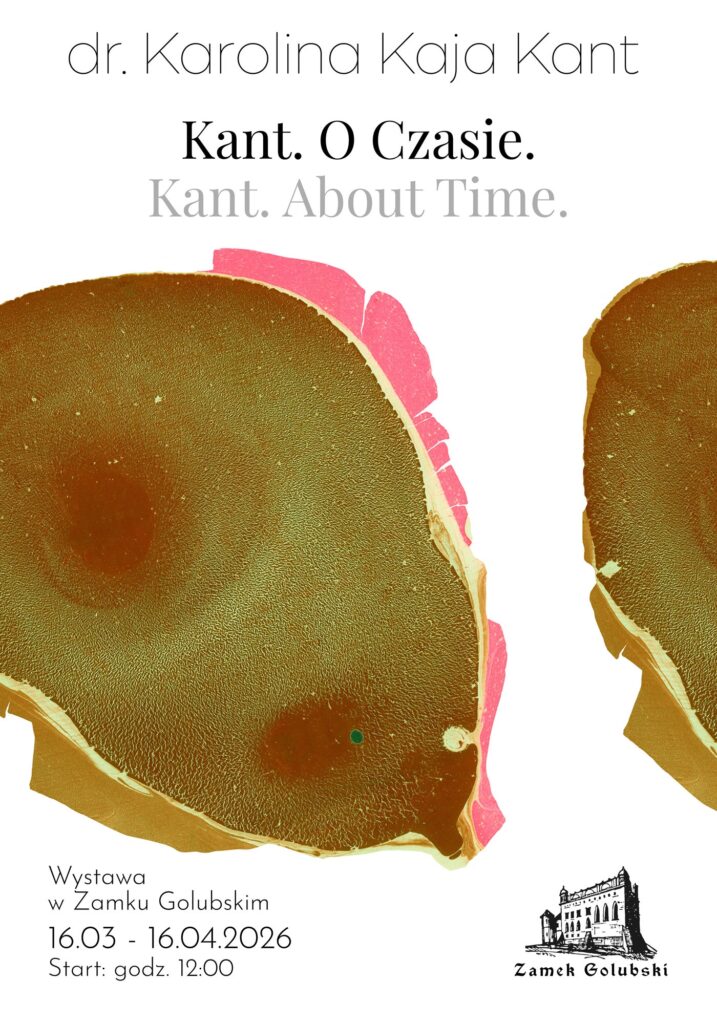
Karolina Kaja Kant cordially invites you to the exhibition “Kant. On Time,” which opened on March 16, 2026, at the Golub-Dobrzyń Castle.
The exhibition will be open to the public until April 16, 2026.
We invite you to visit Golub Castle and embark on this extraordinary journey through time and space.
In the works on display, the artist combines collage with painting, photography, drawing, and printmaking techniques to create hybrid visual compositions. The starting point is the passage of time evident in the structure of tree rings—a natural symbol of transience, continuity, and cyclicality.
For years, Karolina Kaja Kant has been exploring the relationship between nature and humanity, portraying the experience of time as a phenomenon that is both personal and universal. The project is inspired by the philosophy of Immanuel Kant, who wrote:
“Time is not an empirical concept… it is a necessary concept that underlies all sensory data.”
The artist subtly alludes to this idea, creating a narrative rooted in both nature and human experience. The exhibition, which marks the first installment of the series, encourages viewers to engage in personal reflection and experience, leaving many meanings to be discovered in the project’s subsequent phases.
The project operates on a hybrid model:
For more information and to access the online version:
https://www.kajakant.art/events/kant-about-time/
Tree rings are one of the oldest natural records of time—they form layer by layer, archiving the passage of time. Each one is a trace of the past and a foretaste of the future. Time does not simply pass us by—it happens within us.
Just like the rings of a tree, human experience is layered with memory, emotion, and expectation. For the artist, nature becomes a symbol of patience, perseverance, and adaptability. A tree does not resist change, but endures, regenerates, and adapts.
The exhibition is a reflection on time as a record of existence, on the relationship between transience and continuity, and on the relationship between nature and human experience.