The fall edition of " Career Fair "PJAIT is coming up tomorrow—October 22!


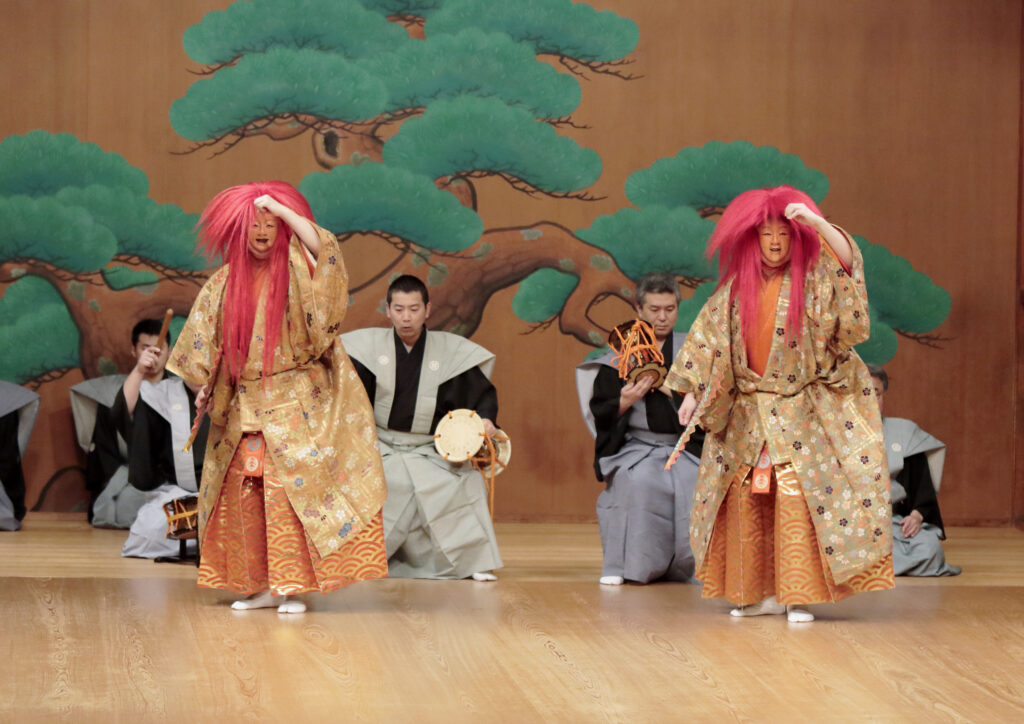
On June 18 at 6:00 PM, the National Theatre in Warsaw will host a performance of traditional Japanese Noh theatre entitled “The Spirit of Wine Shōjō (Midare)” performed by the Hōshō Theatre from Tokyo.
The show was staged and produced by PJAIT lecturerDr. Jakub Karpoluk.
Funds raised from ticket sales will be donated to support Ukraine. These activities are coordinated by the Polish Humanitarian Action.
The Wine Spirit Shōjō (Midare)
Author unknown
translation: Jadwiga Rodowicz-Czechowska
Actors:
Takeda Takashi (main shite actor, Hōshō school) – Wine Spirit Shōjō
Takeda Isa (main shite actress, Hōshō school) – Wine Spirit Shōjō
Noguchi Yasuhiro (second waki actor, Shimogakari Hōshō school) – Kōkū
Ōtomo Jun (Hōshō school) – kōken (assisting master)
Kanamori Yoshimitsu (Hōshō school) – chorus
Kawase Takashi (Hōshō school) – chorus
Tatsumi Kazuma (Hōshō school) – chorus
Kidani Tetsuya (Hōshō school) – chorus
Ueno Yoshihiro (Hōshō school) – chorus
Musicians:
Takamura Yutaka (Issō school) – nōkan flute
Iitomi Yoshiaki (Ōkura school) – kotsuzumi drum
Tsukuda Yoshitarō (Takayasu school) – Ōtsuzumi drum
Nakata Kazuha (Konparu school) – taiko drum
Introduction:
Jakub Karpoluk
The Wine Spirit Shōjō
Long ago in China, in the village of Yōzu at the foot of Mount Kanekin-zan, lived a man named Kōkū. He was a good host and took great care of his parents, so fortune favored him. One night while he was sleeping, a mysterious voice in a dream advised him to sell the wine he brewed at the market in Yōzu, and he would become rich. Indeed, Kōkū began selling wine and became quite prosperous. A customer with the face of a boy regularly bought wine from Kōkū; he drank a lot, but never got drunk, and his face never flushed. Impressed by his high tolerance for alcohol, Kōkū asked him to reveal his name. The mysterious guest revealed that he was not actually human, but a Shōjō, living in the Yangtze River. Before leaving, he asked the host to bring his wine to the river, and he would receive a precious gift. Kōkū went to the Yangtze River carrying wine. After a moment, the Wine Spirit Shōjō emerged from the river in his true form – intoxicated and with a flushed face. Dancing, drinking, and singing, the Shōjō expressed his joy at meeting his friend Kōkū. In gratitude for the wine he received, he presented the man with an endlessly flowing cup. Could this all have been just a dream? Kōkū wondered… However, the magical cup from which wine constantly pours was real, and thanks to it, the protagonist enjoyed prosperity ever after.
The author of the play is unknown; the drama is one of the oldest in the repertoire of the nō theatre; it is also a hiraki mono work – an initiation ritual for the main shite actors. Artists from the Hōshō school will present Polish audiences with an extremely rare version (the so-called kogaki) of the play Midare, subtitled Wagō (Harmony), in which two Wine Spirit Shōjō characters will appear on stage. The play belongs to the fifth group of dramas, the so-called kirinō, which, according to tradition, were performed last during gobandate programs consisting of five dramas
played sequentially.
Jakub Karpoluk
Nō – (能 – Japanese for skill, talent) is one of the three classical Japanese theatres, alongside the actor-based kabuki and puppet bunraku, enjoying a documented history dating back to
the 14th century. It is a poetic and musical theatre. Its roots lie in earlier performance forms, both Chinese and Japanese, sacred and secular, including: dengaku, sarugaku, and kuse mai dances. The classical form of nō theatre, created during the lifetime of Zeami (1364? – 1444?), the progenitor of the Kanze lineage, has survived to the present day, having naturally undergone many transformations. Zeami – actor, playwright, and author of theoretical treatises – remains to this day one of the most important lawmakers of nō dramatic art. In 2001, nō theatre was proclaimed a UNESCO Intangible Cultural Heritage of Humanity.
Jakub Karpoluk