

The fall edition of " Career Fair "PJAIT is coming up tomorrow—October 22!


Gamification is the use of mechanisms known from computer and board games in the context of business, educational, and marketing activities. However, this is not just ordinary fun—it isan advanced strategy that changes the way employees and customers take action, learn, and build brand loyalty.
In today's dynamic market, where competition for consumer attention is increasingly fierce, gamification has become one of the most powerful tools for increasing engagement, motivation, and efficiency. Research shows that companies implementing gamification see a sevenfold increase in conversion rates and observe a significant increase in employee productivity.
Gamification is the art of transforming ordinary, monotonous activities into engaging experiences by applying elements characteristic of games. It involves introducing points, levels, rankings, badges, team challenges, and rewards in situations completely unrelated to traditional games.
The key difference between gamification and ordinary play is that it is not intended purely for entertainment, but rather to achieve specific business goals: increasing sales, improving employee efficiency, increasing customer engagement, or improving educational outcomes.
Gamification mechanisms are based on psychology, principles that are deeply rooted in human nature. People are naturally inclined to compete, achieve goals, gain recognition, and receive rewards. Gamification activates these natural tendencies, creating an environment in which participants want to act—not because they have to, but because they want to.
To understand how gamification works in practice, it is worth familiarizing yourself with the main mechanisms that form its foundation. Each of them plays a specific role in motivating users and building their engagement.
Every bit of progress is measurable and visible to the user. Employees and customers know exactly what their current status is and how far they are from achieving a predetermined goal.
The ability to compare results with other participants triggers a natural competitive instinct. This makes the tasks more engaging.
Symbolic rewards for achievements have motivational power. The appearance of a new badge on your profile gives you a sense of growth and progress.
Clearly defined tasks with a clear goal give meaning to the work. Employees know what to do and why.
Points can be exchanged for real benefits, bonuses, or privileges, which increases the value of the system for its participants.
Gamification in marketing is one of the most spectacular areas of its application. A prime example of this is the Starbucks Rewards program, in which customers collect stars for each purchase and can exchange them for drinks or products.
This program has yielded excellent business results – as much as 40% of Starbucks' total sales come from this program, and individual stores in the chain have seen a 7% increase in sales (source: Harvard).
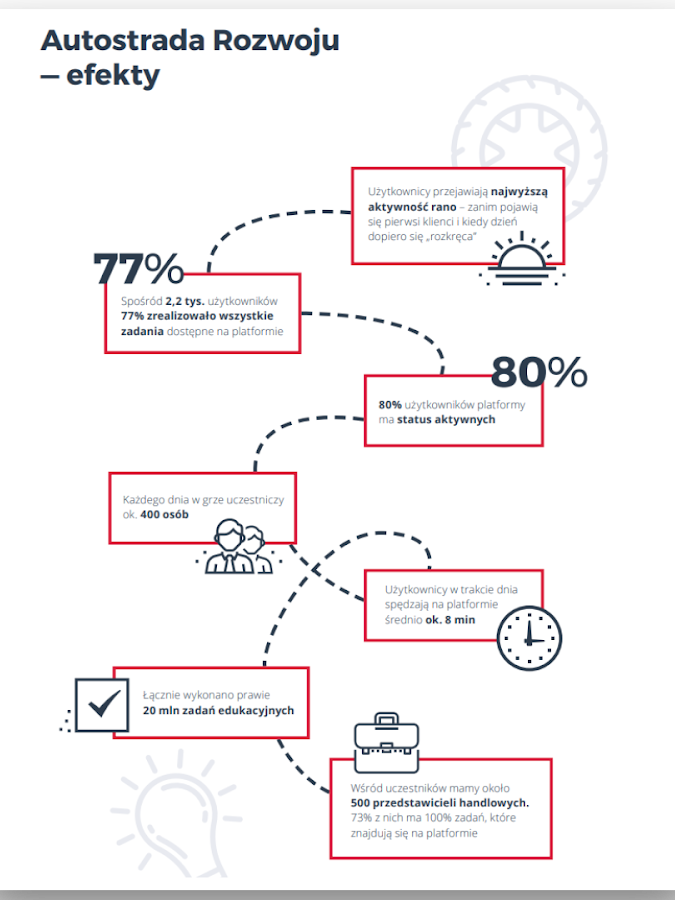
In the field of HR, gamification is used in recruitment, training, internal communication, and increasing work efficiency. An interesting Polish example is a game-inspired platform created by Inter Cars called "Autostrada rozwoju" (Highway of Development), for which the company received the HR INNOVATOR 2016 award.
Employees traveled along a virtual version of the legendary Route 66, collecting knowledge points and promotion badges. This approach not only increased employee engagement, but also accelerated the training process.
There are more and more e-learning platforms that use gamification, and research shows thatstudents who take part in gamified classes are more motivated to learn.
It is impossible not to mention the applications of gamification in sales and customer service, which significantly increases team productivity. Sales rankings, bonuses for achieving goals, and competitions for the best customer service make employees more engaged in their tasks.
For those interested in combining game science with practical business, the MBA for the IT industry offers marketing courses taught by specialists such as Paweł Tkaczyk, author of the renowned book "Gamification: How to Apply Game Mechanics in Marketing Activities." The program combines strategic vision with practical skills for implementing gamification in organizations.
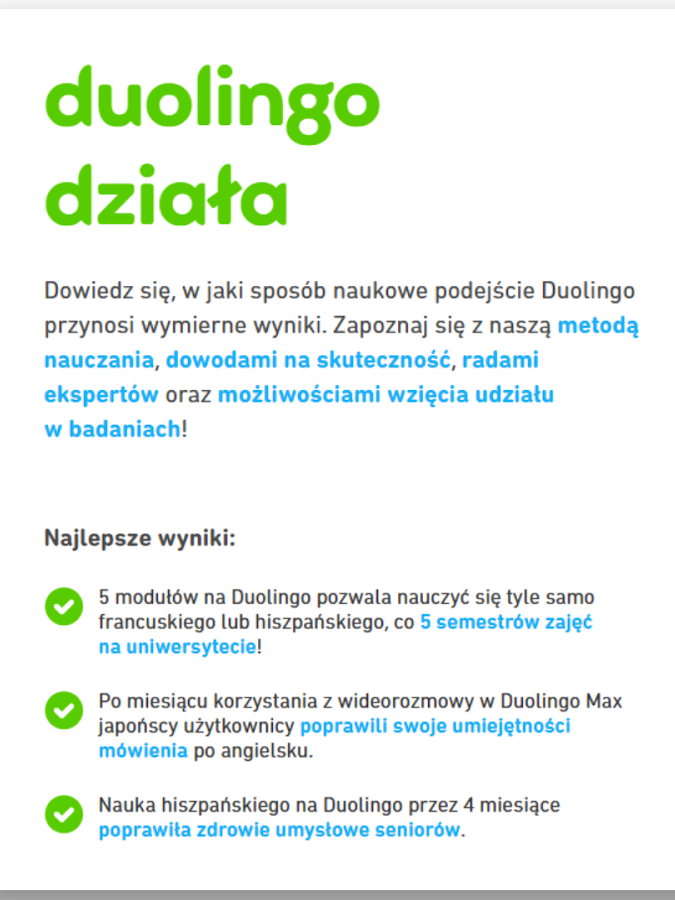
Gamification in education is also extremely effective. The Duolingo language learning app is based almost entirely on gamification mechanisms – "streaks" (consecutive days of learning), achievements, challenges, and rewards. The result is both high user retention and real teaching effectiveness.
First and foremost, it will be a measurable motivation for employees. As we have already mentioned, gamification works on a psychological level – it activates the parts of the brain responsible for satisfaction and goal pursuit. Employees and customers work more effectively when they see clear progress.
For those who want to deepen their knowledge of the psychological mechanisms behind gamification, we recommend the postgraduate program in Game Psychology at the Polish-Japanese Academy of Information Technology. The program allows students to learn about the mechanisms of gamification in business and education and gain an in-depth understanding of the experiences of participants.
Among the other benefits of gamification systems, increased engagement should also be mentioned, as they make monotonous or difficult tasks exciting. Team engagement then increases, which in turn translates into better results.
Building loyalty is also invaluable – gamification programs, especially those with real rewards, make customers return to the brand more often. They feel appreciated and rewarded for their loyalty.
Finally, gamification also facilitates the implementation of changes in organizations, as it provides an effective tool for supporting grassroots initiatives, process improvements, and the implementation of new procedures, in which employees will be more willing to participate.
However, the use of gamification in business is only one element of a modern approach to management and marketing. Effective implementation requires thinking about the user and their needs. Inspiration can be found in the practical approach todesign thinking in the IT industry, which emphasizes the importance of empathy and an iterative approach to problem solving.
For those interested in gaining a deeper understanding of the interactions between technology, communication, and human behavior, field of study the bachelor's degree program: Cognitive Science – Technology, Communication, Design will provide a solid theoretical foundation for working with gamification at all levels.
Let's also remember that gamification is not a passing trend that will fade away with time – it is a continuous evolution in the way organizations have been motivating their employees or customers for many years and achieving their goals in this way. From Starbucks to small Polish companies, gamification mechanisms bring real, measurable results. The key is to understand that gamification is not art for art's sake, but a well-thought-out tool based on the psychology of human behavior.