PJAIT BYTOM
The choice of specialized area is made in the second year of full-time studies or in the third year of part-time studies. Students decide on the choice of area by filling out a questionnaire. Each student is required to choose one area to continue their studies. Students who would like to opt for two areas at the same time should indicate their choice in the questionnaire. Information about the survey and the time for its completion is provided to students annually. Once its time is up, it is not possible to change the decision.
Specialty ranges:
Characteristics of the specialized scope
Areas of specialized scope are the acquisition, processing and understanding of image information contained in a single frame as well as a video stream. Image information is acquired from monochrome, RGB, RGBZ, multispectral and multispectral cameras in systems: single camera,
static or moving, camera system with particular emphasis on stereo configurations. Low-level processing includes noise reduction, medium-level feature extraction and selection, representations in selected orthogonal function systems. Understanding image information means classifying image content based on a feature vector or deep neural network. Different types of networks like DNN, LSTM, Transformer and different network learning strategies using publicly available image databases are analyzed. Applications using video information including intelligent monitoring to detect behavior and interactions and VR (Virtual Reality) and AR (AugmentedReality) applications are analyzed. For the purpose of completing the engineering thesis, students will be given extended access to specialized laboratories and computing infrastructure of the CBR PJAIT described in detail in section: Laboratories, unique databases, CBR computing cluster PJAIT. Graduates can find work as developers of a wide range of applications using vision-based sensory systems starting from monitoring systems to autonomous vehicles.
Obligatory subjects for specialization
DOW (Diagnostics based on image and video), RZW (Recognition of behavior in video data), WMA (Machine vision)
Characteristics of the specialized scope
The area of specialized scope is the programming of computer games and VR (Virtual Reality) and AR (AugmentedReality) environments using Unity and Unreal engines covering scene creation, character creation, including character animation using retargeting from VICON footage and facial animation using the VICON Bonita system or synchronized video camera system. The degree program is designed by active industry developers and emphasizes the acquisition of extensive practical knowledge in game development. Subjects include game design also for VR and AR environments where HTC vive or META goggles will be used. Graduates of the specialized scope are able to program powerful real-time applications, and are also proficient in creating 3D visualizations and animations. For the purpose of completing an engineering thesis, students will be given expanded access to specialized laboratories and computing infrastructure of the CBR PJAIT described in detail in section: Laboratories, unique databases, CBR computing cluster PJAIT. Graduates can find work as programmers of computer games, developers of commercials and other multimedia applications of any type.
Obligatory subjects for specialization
SYK (Computer Simulation), ADR (Analysis of Traffic Data), PRM (Mobile Programming).
Characteristics of the specialized scope
An area of specialized scope is the programming of controls and behavior of autonomous mobile platforms moving in a plane, such as cars, or in space like drones based on information provided by on-board or ground sensors. Problems will be analyzed:
- The realization of the set trajectory and the accuracy of its execution depending on the sensors and interference used,
- Navigating in an unfamiliar environment including avoiding obstacles,
- swarm implementation.
Remote control of platforms based on the platform's camera image in FPV mode will be analyzed independently. The developed control and behavioral algorithms will be simulation tested in environments: AirSim, ROS, Gazebo. Positive test results will be the basis for implementation in physical platforms and testing in the VICON reference laboratory. For the purpose of completing the engineering thesis, students will be given extended access to specialized laboratories and computing infrastructure of the CBR PJAIT described in detail in section: Laboratories, unique databases, CBR computing cluster PJAIT. Graduates in the specialized field will find employment in the growing field of services using remotely controlled or autonomous mobile platforms.
Obligatory subjects for specialization
SYK (Computer Simulation), ISS (Intelligent Control Systems), WMA (Machine Vision).
Characteristics of the specialized scope
The area of specialization is the programming of application software to support diagnostics and therapy in the fields of medicine, broadly defined health care, physiotherapy and sports. Collaborative efforts between doctors and engineers produce tools and measurement methods that underpin safe procedures with scientifically proven effectiveness. Most mHealth applications are concerned with improving overall health. However, the number of applications for health management and disease diagnosis is growing rapidly, now accounting for 40% of all health-related applications. Applications may include, for example :
- orthopedics - motor rehabilitation support based on human movement acquisition costume, reference CAREN system and voice feedback
- Angiology, rheumatology - segmentation of ultrasound images using machine learning technology
- Oncology-Segmentation of PET images
- psychology- immersive environments in computer game technology
- Psychiatry-The study of features from the autism spectrum based on facial images in response to imaging stimulation
- Neurology-Sensory integration, supporting a person with PD by generating periodic stimuli, psychophysical activation of the elderly.
For the purpose of completing the engineering thesis, students will be given expanded access to the specialized laboratories and computing infrastructure of the CBR PJAIT described in section: Laboratories, unique databases, CBR computing cluster PJAIT. Graduates in the specialized field will find employment in companies developing specialized software to support diagnostics and therapy.
Obligatory subjects for specialization
ADR (Acquisition of video data), DOW (Diagnostics based on image and video), RZW (Recognition of behavior in video data)
Laboratories, unique databases, CBR computing cluster PJAIT made available to students for engineering dissertations
The laboratory has a multispectral imaging system that consists of a liquid crystal filter and a CCD camera using Edmund optical components. The key component of the multispectral imaging system is a voltage-controlled liquid crystal filter. The essence of the filter is, depending on the specified voltage, to create a spectral window of radiation transmittance. Depending on the wavelength, both the width of the spectral window and the attenuation in the window change, which requires appropriate amplitude correction of the acquired images. For a fixed spectral window, one monochromatic image with a resolution of 658×496 with a 16-bit range of pixel brightness values is recorded.
The lab has a Vicon motion kinematics acquisition and analysis system equipped with 20 NIR cameras operating at acquisition speeds from 100 to 2,000 frames/sec with a 4 mega-pixel matrix resolution and eight-bit gray depth. Noraxon's dynamic electromyography (EMG) system provides 16-channel measurement of muscle potentials using gel-free electrodes according to SENIAM guidelines. Kistler's ground reaction force (GRF) measurement system enables measurement of ground reaction forces using two dynamometer platforms with measurement ranges suitable for gait analysis data acquisition. Basler's simultaneous multi-camera video recording system enables simultaneous video recording from all video cameras in full HD, and lossless video recording. The system uses color video cameras using the GigE Vision standard and industrial lenses.
The lab has a camera that operates at an acquisition rate of 200 fps and stores raw data in a separate computer, and specialized lighting adapted in high acquisition speed.
The lab has 8 high-performance workstations, 120TB of disk space, 2 HD PTZ cameras located at the entrance of the building connected by a fiber optic infrastructure to video data acquisition computers, a camera for recording high-speed phenomena (210 fps), a 10GB fiber optic infrastructure inside the lab, a 1GB connection to the cameras, a virtualization environment, a continuous integration environment, a development environment, a distributed (remote) work environment. The lab enables projects in the area of computer vision. The main field of activity is work in the field of usability and implementation of CV (Computer Vision) methods in the context of 4th generation surveillance systems (IVA - Intelligent Video Analysis).
The laboratory has a Bonita facial marker position acquisition system (Vicon company) equipped with 10 NIR cameras operating at an acquisition speed of 120 frames/sec with a matrix resolution of 2 mega pixels and eight-bit gray depth, a simultaneous synchronous 6-camera video recording system with Point Gray Glasshopper 3, 162 fps, 1920×1200 cameras enabling simultaneous image recording from all video cameras, and lossless video recording, the system uses color video cameras using USB 3 interface.0 to work with a dedicated recording computer.
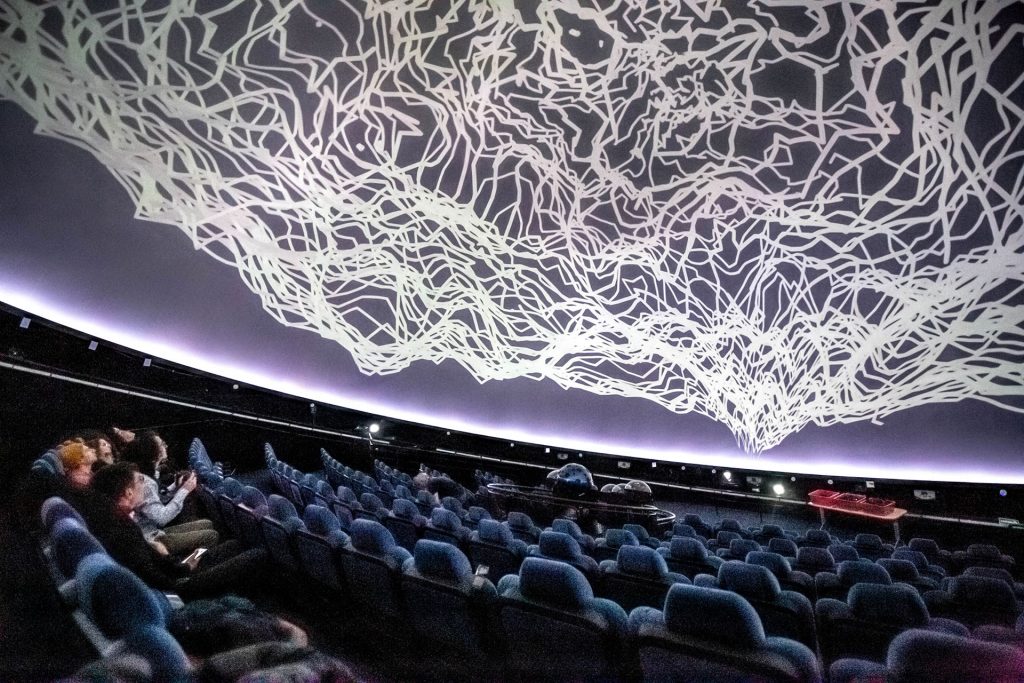
The lab has a six-degree-of-freedom platform with a built-in treadmill with two independent treadmills for both legs with full-length pressure platforms under the treadmill with independent and simultaneous measurements for both limbs. The treadmill allows for interaction and unforced walking. The mobility of the platform allows the actor/patient to influence behavior. The Motion Capture system, consisting of 10 NIR cameras, together with a real-time operating system, allows the acquisition of the actor/patient's gait forced by the movement of the platform. A projection system in the form of a semicircular screen creates the illusion of presence in the scene projected on the screen. The audio system, generates high-quality surround sound, surrounding the actor/patient. It is an active element supporting interaction and feedback functions.
Data produced as a result of the laboratories' work to date is available through the CBR Resources (CBR RES) system, which is a web-based environment that allows access to CBR resources PJAIT as well as remote access to the CBR Laboratories. Resources can be accessed by logging in with a pre-registered account or by using a Google account login. The shared collections contain data collected during research at CBR Laboratories PJAIT. Each collection has a description of the study, collection and measurement configuration, the data is zipped for download and includes a sample reference file.
Computing cluster providing infrastructure: virtual environments, compute servers, data servers, labs. Security system, meeting the requirements of the Law on Personal Data Protection. The cluster has the following technical parameters: Computing: 23 nodes, 20 x Tesla K80, 2 x NVidia K2, 664 core CPU, 7TB RAM. Memory: 1.2 PB, dynamic tiering, architecture for sequential and random operation, 15 MB/s (read), media: SSD (3TB), SAS (184TB), NL-SAS (1092TB) The hardware infrastructure of the computing cluster is shown in the table below.