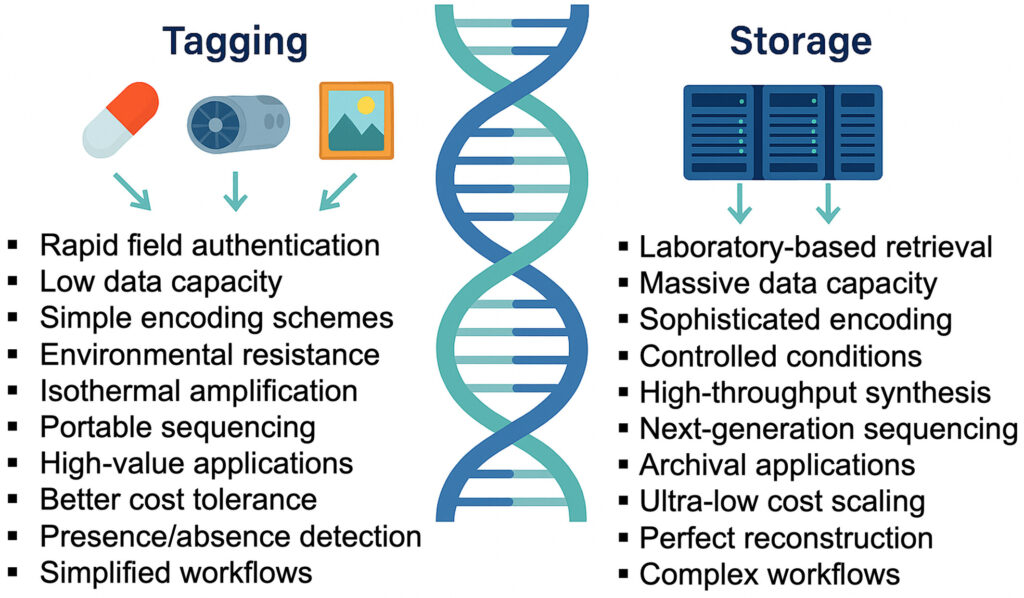
On July 16, 2025, a scientific paper entitled "Advances in DNA Tagging and Storage: Techniques, Applications, and Future Implications" was published in the prestigious journal WIREs Computational Molecular Science (IF 2024: 27.0; SJR: Q1; 200 pts MEiN). "Advancements in DNA Tagging and Storage: Techniques, Applications, and Future Implications." The authors are from the Department of Bioinformatics at the Polish-Japanese Academy of Information TechnologyPJAIT), with colleagues.
What the publication contains:
- A comprehensive analysis of DNA tagging and information storage technologies in the form of a DNA polymer.
- Discussion of key technical issues: durability (stability), readability (read accuracy), resistance to degradation, ways to encode and read data.
- comparing the cost-effectiveness of different methods and evaluating their suitability, in applications such as data archiving on biological media.
- Identification of challenges facing larger-scale implementation, including long-term stability, method standardization, material costs, and environmental resilience.
Why it's important:
DNA is a material that theoretically allows for the storage of huge amounts of data packed into a small volume of polymer and long-term archiving. The research shows that these methods could become a viable alternative to classical technologies currently in use.
Practical applications include data storage, marking physical objects (e.g., marking works of art, vehicles, equipment), archives, among others.
The publication raises the profile of PJAIT 's Department of Bioinformatics in the international research community, especially in the areas of DNA data storage and molecular tagging.