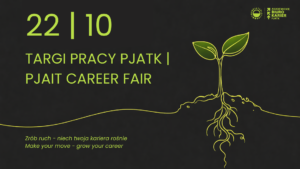
The fall edition of " Career Fair "PJAIT is coming up tomorrow—October 22!

Participants in the third edition of the PJAIT AI Summit, to be held on September 16, 2026, at the Polish-Japanese Academy of Information Technology in Warsaw, will seek answers to these questions. Among the event’s most prominent guests will be Prof. Andrzej Dragan, Jacek Dukaj, and Dr. Bartosz Naskręcki. For Prof. Dragan, this will mark his third appearance at a conference organized byPJAIT.
The PJAIT AI Summit brings together perspectives that rarely converge on a single stage: science, technology, business, culture, and the arts. This year’s edition will focus, among other things, on robotics and automation, deepfakes, security and defense, as well as the social and cultural implications of the development of artificial intelligence.
One of the most compelling scientific perspectives at the conference will be presented by Dr. Bartosz Naskręcki—a mathematician specializing in algebraic geometry, number theory, and the applications of artificial intelligence in mathematical research. He was the only Pole on the international team that developed FrontierMath—an advanced benchmark that tests the ability of AI models to solve complex mathematical problems. His experience allows him to pose one of the most important questions in the contemporary debate on AI: Do these models actually reason, or do they merely process known patterns with increasing efficiency?
Prof. Andrzej Dragan is a theoretical physicist, science communicator, photographer, and filmmaker. At the Faculty of Physics of the University of Warsaw, he conducts research on topics including the theory of relativity, quantum field theory, and relativistic quantum information. Combining the precision of a scientist with the experience of an artist, he demonstrates that discussions about new technologies cannot be limited to the parameters of models and the pace of development of tools—they must also address the way in which technology changes our perception of reality.
Professor Dragan has been involved with the PJAIT AI Summit since its first edition, and in 2026 he will be speaking at the conference for the third time. PJAIT also pleased to host him for special lectures held as part of the MBA program for the IT industry. His regular presence strengthens the connection between open conference debate and the education of leaders responsible for technological change within organizations.
Jacek Dukaj—a writer, essayist, and one of Poland’s most important science fiction authors—has for years been exploring the transformations of humanity, language, and culture under the influence of technology. In his books and essays, he addresses topics such as technological singularity, art in the age of AI, communication, and the relationship between values and the development of civilization. His participation in the PJAIT AI Summit will broaden the debate to include questions that cannot be answered by technical solutions alone: Who are we becoming in a world of increasingly intelligent machines, and what kind of future do we consciously want to shape?
Jacek Dukaj was also a guest at the previous edition of the conference. In 2025, together with Prof. Andrzej Dragan, he took part in the discussion “Quo Vadis AI,” moderated by Dariusz Rosiak. The meeting between the scientist and the writer became one of the most memorable highlights of the PJAIT AI Summit—a dialogue blending scientific knowledge, imagination, and bold questions about the future of humanity in a world of increasingly advanced machines.
The PJAIT AI Summit is not only a forum for exchanging views but also a platform for long-term collaboration between education and business. Companies contribute their knowledge of real market needs and implementation experience, whilePJAIT the academic, teaching, and expert resources. As a result of this collaboration—which has also been developed during previous editions of the conference—PJAIT has launched five new postgraduate programsPJAIT the past twelve months in partnership with its business partners.
The conference demonstrates that responsibly preparing people and organizations for technological transformation requires dialogue among the scientific community, business, culture, and society.
Date:September 16, 2026, at 8:30 a.m.
Location: Polish-JapaneseAcademy of Computer Science, 86 Koszykowa St., Warsaw
Program and information: aisummit.pja.edu.pl
The guests at the PJAIT 2026 AI Summit will also include Tomasz Bagiński, Sławomir Idziak, and Jacek Rokosz. Their participation will offer a perspective on artificial intelligence through the lens of film, visual arts, new media, and the creative process. Bringing together such a diverse group of experts will create a space for discussion not only about the possibilities of the technology, but also about responsibility, risk, and the directions of change that AI is setting for business and society.
This year, “Raport o stanie świata” has become the media partner of the PJAIT AI Summit—a highly regarded journalistic project created by Dariusz Rosiak and a team of authors that helps readers better understand the most important changes of our time. PJAIT “Raport o stanie świata” are planning joint communication initiatives to ensure that information about the conference, its guests, and the topics discussed reaches the widest possible audience interested in the impact of artificial intelligence on the world.
This partnership reinforces one of the event’s main goals: to foster an in-depth, multi-perspective debate on AI—without oversimplifications, but with curiosity, critical thinking, and responsibility.
The conference will open with a lecture by Jacek Rokosz, a lecturer PJAIT a specialist who collaborates with international film productions. His presentation will focus on the impact of artificial intelligence on the audiovisual world and the changes taking place in the image-creation process.
Sławomir Idziak, one of Poland’s most distinguished cinematographers, will discuss the technological transformation of cinema and the responsible use of new tools.
Another highlight of the program will be a series of debates featuring Prof. Andrzej Dragan, Jacek Dukaj, Tomasz Bagiński, and Bartosz Nastręcki. The discussions will focus, among other things, on the impact of AI on culture, the media, security, creativity, and the way modern organizations operate.
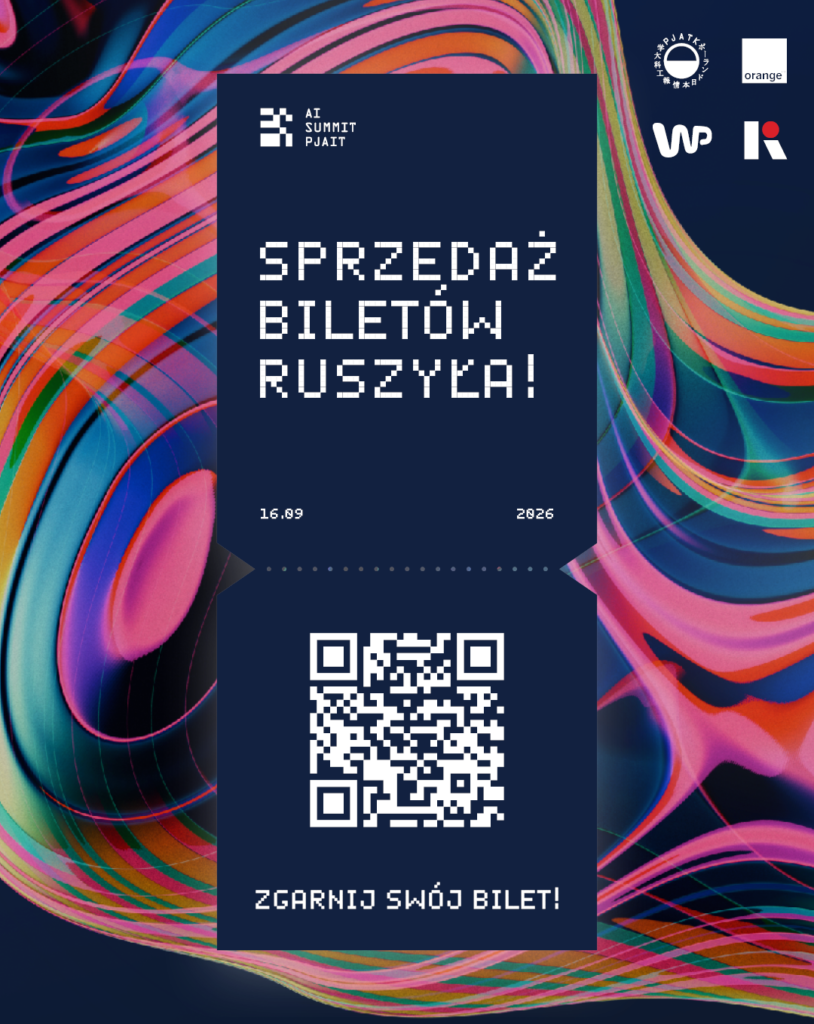
ATTENTION! Space is limited—don't wait until the last minute; buy your ticket now!
September 16, 2026